

What Is HR? Responsibilities and Qualities of a Good HR Professional
HR (Human Resources) is the department responsible for supporting employees throughout their employment lifecycle, from recruitment, hiring, and pay to development, performance reviews, and separation. It also ensures that the company complies with Thailand's Labour Protection Act B.E. 2541 (1998). A commonly used median benchmark is 1.4 HR staff per 100 employees.
Example: A company with 250 employees should have approximately 250 × 1.4 ÷ 100 = 3.5 HR staff or one HR staff member for an average of approximately 100 ÷ 1.4 = 71 employees.
Table of Contents:
- What Is HR? Responsibilities and Qualities of a Good HR Professional
- What Is HR, and What Does It Stand For?
- What Are HR's Responsibilities?
- How Does the HR Process Work, from Opening a Position to Performance Reviews?
- What Is the Difference Between HR, HRM, and HRD?
- What Qualities Should a Good HR Professional Have?
What Is HR, and What Does It Stand For?
HR stands for Human Resources and refers to an organization's workforce. Within organizations, the term is used for both the HR department and the people who work in that department as in "Submit your leave request to HR."
HR has three main roles:
- Supporting employees From recruitment and support during employment to resignation or retirement.
- Connecting employees and management Acting as a mediator when departments face people or work-related issues and helping resolve them.
- Ensuring legal compliance Covering labour laws, social security, income tax, and the protection of employees' personal data.
HR is important to every organization, especially medium-sized and larger companies with employees across multiple departments, because people management involves a substantial workload and statutory deadlines.
What Are HR's Responsibilities?
HR has a wide range of responsibilities, as detailed below.
1. Recruiting and Staffing
HR's primary responsibility is to recruit employees for departments that need them. This starts with creating a for job advertisements across various channels, including details of what applicants will receive. At this initial stage, HR screens applicants before referring them to department heads for interviews.
2. Employee Training and Development (Training)
HR needs to identify to develop employees' capabilities, including job-related skills, skills for more senior roles, and personal development, so that employees can work more effectively.
3. Compensation and Payroll Management (Payroll)
At the managerial level, HR sets hiring budgets and evaluates whether the pay offered is appropriate for new hires' capabilities. HR also helps make decisions on after department heads complete performance reviews. Routine monthly responsibilities include , withholding tax, and remitting social security contributions.
4. Resolving Problems and Reducing Conflict (Conflict Resolution)
HR connects all departments. When departments disagree, employees have conflicts with one another, or an employee struggles to perform their work, HR helps resolve the issue and reduce conflict. Workplace rules and regulations provide a framework for helping departments work together smoothly.
For a detailed look at seven areas of HR responsibility and the job titles in each, see
How Does the HR Process Work, from Opening a Position to Performance Reviews?
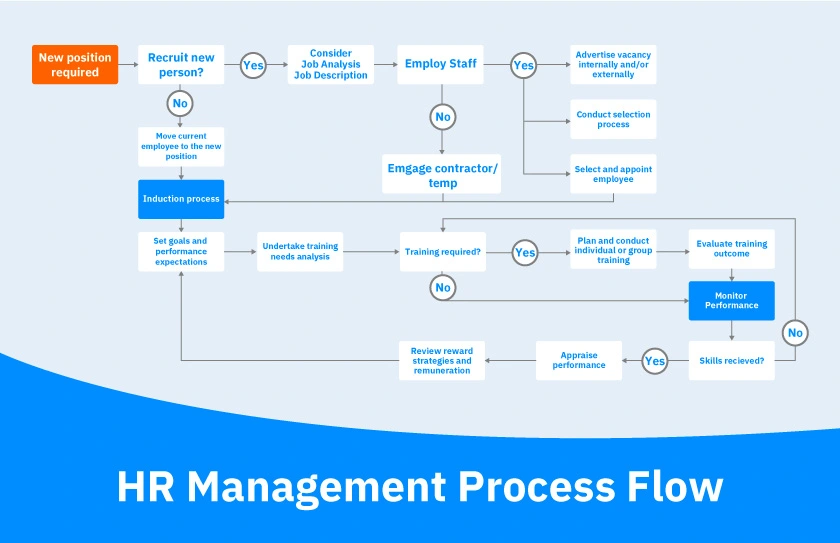
The HR Management Process Flow consists of nine steps:
- A new position becomes available — A department reports its staffing needs. HR decides whether to recruit a new employee. If not, an existing employee is transferred to the role, and the process moves directly to Step 4.
- Analyze the role and write a Job Description Define the responsibilities and qualifications for the position.
- Hire a permanent employee or engage a contractor or temporary employee For permanent hires, advertise the vacancy internally and externally, select candidates, and appoint the successful applicant.
- Orientation (Induction) Introduce the role, workplace rules, and colleagues.
- Set work goals and expectations
- Analyze training needs If training is required, plan individual or group training and then evaluate its results.
- Monitor performance If the required skills have not yet been acquired, return to Step 6.
- Evaluate performance Learn how in
- Review compensation and rewards Then return to setting goals for the next cycle (Step 5).
What Is the Difference Between HR, HRM, and HRD?
HR refers to the department or people responsible for personnel matters. HRM manages people throughout the entire employment lifecycle, while HRD is part of HRM and focuses on developing employees' capabilities.
| Aspect | HR | HRM | HRD |
|---|---|---|---|
| Stands for | Human Resources | Human Resource Management | Human Resource Development |
| Meaning | Personnel department / human resources | Managing human resources | Developing human resources |
| Scope | The department or people responsible for personnel matters | The full employment lifecycle, from recruitment to separation | Training, skills development, and career development |
| Goal | Manage day-to-day personnel matters | Help people reach their full potential and support organizational growth | Improve employees' capabilities and prepare them for change |
| Relationship | The department responsible for both HRM and HRD | Includes HRD | Falls under HRM |
Read more: ·
What Qualities Should a Good HR Professional Have?
- Strong interpersonal skills and the ability to get along with others easily
- The ability to understand others, provide support, solve problems, and reduce interpersonal conflict effectively
- Impartiality and a willingness to listen objectively to others' views
- A broad understanding of different roles; in-depth expertise is not essential, but a reasonable level of understanding is needed
- A belief that everyone can develop their abilities
- Responsibility for assigned duties
Tips Discover useful insights in 12 Benefits of CRM Systems: Improve Customer Service and Support Organizational Development
FAQ: Frequently Asked Questions
Q: Are HR and the personnel department the same?
A: Yes. HR is the English term for the personnel or human resources department. Some organizations use names such as People Team, but the core responsibilities are the same: supporting employees from recruitment and pay through development and separation.
Q: Does a small company need HR?
A: The law does not require a dedicated HR position. However, employers with 10 or more employees must maintain workplace rules and an employee register under Sections 108 and 112 of the Labour Protection Act. They must also register employees for social security within 30 days. In small companies, the owner or accounting department therefore often handles HR duties alongside their other responsibilities initially.
Q: What degree do I need to work in HR?
A: There is no restriction on the field of study. Common backgrounds include human resource management, psychology, business administration, law, and political science. Knowledge of labour law, communication skills, and proficiency in HR or payroll software are more important.
Read more related articles


