

What Is a KPI? Performance Evaluation for Organisational Success
A KPI (Key Performance Indicator) is a numerical measure of how well an employee, team or organisation achieves agreed goals, such as monthly sales, customer satisfaction or time to fill a vacancy. Organisations use KPIs to evaluate performance, decide salary increases and bonuses, and track business progress. Effective KPIs should follow the SMART framework and cascade from the organisation to departments and individual employees.
Table of Contents:
- What Is a KPI? Performance Evaluation for Organisational Success
- What Is a KPI, and What Does It Stand For?
- What Types of KPIs Are There?
- How to Set Effective KPIs Using SMART
- How to Set KPIs: Step by Step
- KPI vs. OKR: What Is the Difference?
- Summary: What Is a KPI? Performance Evaluation for Organisational Success
- FAQ: Frequently Asked Questions About KPIs
What Is a KPI, and What Does It Stand For?
KPI (Key Performance Indicator) measures performance against agreed standards or targets using clear numerical values. It is used to assess employee performance, track organisational progress and improve operational efficiency.
• K stands for Key: The core focus, main objective or key to success.
• P stands for Performance: Efficiency, effectiveness or the ability to perform work.
• I stands for Indicator: A measure or assessment criterion.
What Types of KPIs Are There?
KPIs can be classified in two main ways: by measurement method (direct or indirect) and by perspective (positive or negative).
| Classification | Type | Meaning | Examples |
|---|---|---|---|
| By measurement method | Direct measurement (quantitative) | Uses actual, verifiable numbers without requiring interpretation. | Sales, units produced, days required to complete a task |
| By measurement method | Indirect measurement (qualitative) | Uses opinions or assessments that must be converted into scores. | Customer satisfaction scores, communication skills assessment results |
| By perspective | Positive KPI (higher is better) | Measures successful outcomes. | Sales, profit, customer satisfaction, production capacity |
| By perspective | Negative KPI (lower is better) | Measures defects, problems or losses. | Production defects, complaints, employee turnover rate |
How to Set Effective KPIs Using SMART
Effective KPIs follow the SMART framework: Specific, Measurable, Achievable, Realistic/Relevant, and Time-bound.
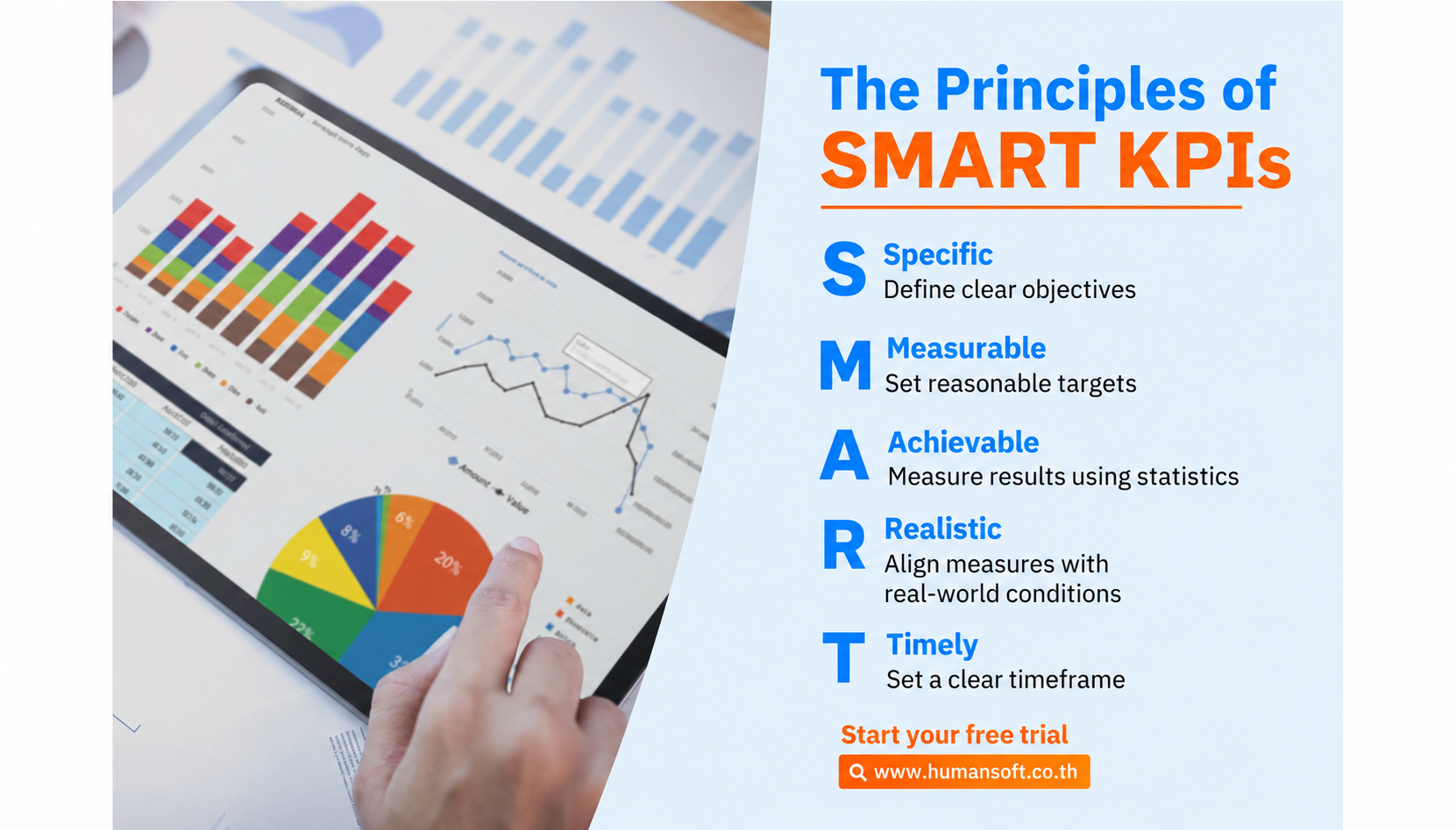
- S – Specific : Set specific objectives or targets with a clear, focused scope.
- M – Measurable: Measure performance using statistics or numerical data to support clear decisions.
- A – Achievable : Set realistic, achievable goals that are still challenging relative to the company's size.
- R – Realistic : Align performance measures with real-world conditions. For example, profits may decline during an economic downturn.
- T – Timely : A clear timeframe is essential for measuring success. Without a defined deadline, goals may not be achieved.
TIPS! Download the free e-book "5 Ways to Set KPIs Your Team Will Follow" here >> 5 Ways to Set KPIs Your Team Will Follow
How to Set KPIs: Step by Step
Set KPIs from the top down across four levels: organisational indicators → departmental indicators → individual indicators → secondary indicators. Each level must align with the level above it and suit the organisation's policies and size.
- Define Organisational Indicators Start with the organisation's main goals or policies to guide every department and measure overall progress.
- Define Departmental Indicators Break organisational goals into targets for each division or department so that every unit contributes. Indicators may differ by function.
- Define Individual Indicators Translate departmental goals into targets for each employee. This is the smallest but most important level: well-designed individual KPIs support organisational success and fair salary decisions.
- Define Secondary Indicators Add qualitative measures, such as customer satisfaction with service, for a more comprehensive evaluation.
- Set Weights and Evaluation Periods Ensure the weights of all indicators total 100%, and agree on a review schedule, such as monthly or quarterly.
KPI vs. OKR: What Is the Difference?
KPIs measure routine performance against expected targets, while OKRs (Objectives and Key Results) set ambitious goals to drive change. Many organisations use both: KPIs support ongoing operations, while OKRs focus on areas where substantial improvement is desired.
| Aspect | KPI | OKR |
|---|---|---|
| Purpose | Measure the efficiency of routine work | Drive ambitious new goals |
| Target level | Realistically achievable; 100% completion is expected | Ambitious; achieving around 70% is considered good |
| Goal-setting cycle | Usually annual, with monthly or quarterly tracking | Usually quarterly |
| Link to compensation | Often linked to salary increases and bonuses | Usually not directly linked |
| Example | Achieve 100% of the monthly sales target | O: Become the market leader in the northern region / KR: Acquire 50 new customers in the northern region |
Summary: What Is a KPI? Performance Evaluation for Organisational Success
A KPI is a numerical measure of progress towards a target. Use SMART to set effective KPIs, cascade goals from the organisation to individuals, define clear weights and monitor results regularly. This supports fair performance evaluation and helps the organisation achieve its goals.
If your organisation still evaluates KPIs using Excel, lets you create evaluation forms, define KPIs and set evaluation periods in the same system as your employee data.
FAQ: Frequently Asked Questions About KPIs
Q: How many KPIs should an employee have?
A: Generally, 3–7 KPIs, with weights totalling 100%. Too many make it difficult to focus on important work, while too few may not provide a comprehensive assessment.
Q: How are KPI scores calculated?
A: Calculate the achievement percentage for each indicator as (actual result ÷ target) × 100, then multiply it by the indicator's weight. Add the weighted results to obtain the overall KPI score. For indicators where lower is better, reverse the formula to (target ÷ actual result) × 100.
Q: What are examples of HR KPIs?
A: Examples include time to fill vacancies, employee turnover rate, the percentage of employees who pass probation, and submission of complete payroll data before the payroll cut-off date.
Q: How often should KPIs be evaluated?
A: Most organisations set annual targets and conduct formal evaluations 1–2 times a year. Progress should also be tracked monthly or quarterly so problems can be addressed before the evaluation period ends.
Read Related Articles


