
What Is an NDA? What HR Should Know Before Employees Sign One
NDA stands for Non-Disclosure Agreement. It specifies what information must remain confidential, who must protect it, how long the obligation lasts, and what liability arises from a breach.
Table of Contents:
- What Is an NDA? What HR Should Know Before Employees Sign One
- What Does NDA Stand For and What Does It Mean?
- What Should an NDA Include?
- What Happens If Someone Breaches an NDA?
- When Should HR Ask Employees to Sign an NDA?
- Why Do NDAs Matter to Organizations?
- What HR Should Know About NDAs
- FAQ : Frequently Asked Questions About NDAs
What Does NDA Stand For and What Does It Mean?
NDA stands for Non-Disclosure Agreement, an agreement not to disclose information. In Thai, the term commonly used means confidentiality agreement. Some companies use the name Confidentiality Agreement (CA), which means the same thing.
An NDA is a contract in which the receiving party agrees not to disclose the other party’s confidential information or use it outside the agreed purpose. Information commonly treated as confidential includes the following.
- Business information: Business plans, marketing strategies, costs, and purchase or sale negotiations
- Customer and business partner information: Names, contact details, and commercial terms
- Technical information: Formulas or manufacturing processes, source code, and products in development
- Internal company information: Financial data, payroll information, and passwords for company systems
What Forms Can an NDA Take?
NDAs, also known as confidentiality agreements, generally fall into three categories based on how many parties have a duty to keep information confidential.
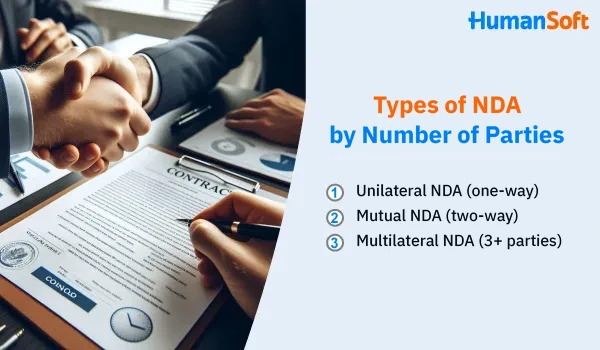
1. Unilateral NDA
Under this agreement, only one party discloses or shares confidential information with the other. For example, an employee may be given access to company usernames and passwords and must keep those credentials confidential. In this case, only one party has a duty to maintain confidentiality.
2. Mutual NDA
Both parties disclose or share confidential information with each other, and each must protect the other party’s information. Each party acts as both a discloser and a recipient. For example, Company A and Company B may sign an NDA to protect the sensitive information they exchange while developing a new product together.
3. Multilateral NDA
This confidentiality agreement covers three or more parties that share information. One or more parties may disclose information, and every recipient must keep it confidential. For example, Company A, Company B, and Company C may sign an NDA to protect the information they exchange while working on a new technology project together.
What Types of NDAs Are There by Duration?
Based on when they expire, NDAs fall into two categories: agreements with an end date and agreements without one.
1. Fixed-Term NDA
A fixed-term confidentiality agreement expires when the agreed period ends and the disclosing party releases the recipient from its obligations. The agreement may specify an end date or expire when the business relationship ends.
2. NDA Without an End Date
An NDA without an end date requires the recipient to keep the information confidential throughout the working relationship with the disclosing party or until the information becomes public.
What Should an NDA Include?
A practical NDA should cover at least eight points.
- Parties: Each party’s name, address, and authorized signatory
- Purpose: Why the information is shared and the specific purpose for which the recipient may use it
- Definition of confidential information: The types of information covered, defined precisely enough to avoid ambiguity
- Exceptions: Information already in the public domain, already known to the recipient, lawfully obtained from a third party, or required to be disclosed by court order or law
- Recipient’s obligations: How to safeguard the information and who within the organization may access it
- Duration: How long the agreement applies and how many years the confidentiality obligation continues after it ends
- Return or destruction of information: How many days the recipient has to return documents and delete files after the work ends or the employee resigns
- Consequences of breach: Damages, contractual penalties, governing law, and the courts with jurisdiction
See a sample employee agreement in the Employment Contract Template
What Happens If Someone Breaches an NDA?
Anyone who discloses confidential information or uses it outside the agreed purpose is liable under the contract and may also face consequences under other laws.
| Consequence | Legal Basis | What It Means |
|---|---|---|
| Payment of damages | Thai Civil and Commercial Code provisions on the consequences of non-performance of obligations | The injured party may claim damages resulting from the breach. |
| Payment of an agreed contractual penalty | Thai Civil and Commercial Code, Sections 379–383 | The injured party may claim the contractual penalty. If it is disproportionately high, the court may reduce it to a reasonable amount under Section 383. |
| Court order to stop the infringement | Trade Secrets Act B.E. 2545 (2002) | If the information is a trade secret, its owner may ask the court to stop the disclosure or use of the information and may claim damages. |
| Possible dismissal | Labour Protection Act B.E. 2541 (1998), Section 119 | If an employee intentionally reveals confidential information and causes harm to the employer, the employer may dismiss the employee without severance pay. |
Employees also have legal protection. If a term in an employment contract, such as a contractual penalty, gives the employer an undue advantage, the court may enforce it only to the extent it considers fair under Section 14/1 of the Labour Protection Act.
When Should HR Ask Employees to Sign an NDA?
- On the first day of work: Have employees sign it alongside the employment contract so their confidentiality obligations apply from day one.
- Before granting access to sensitive information: This may apply when an employee moves into a role involving customer data, financial information, or a new project.
- Before starting a project with a business partner: Use a mutual NDA before exchanging sensitive details.
- When an employee resigns: Remind the employee of any ongoing NDA obligations, collect company documents and devices, and revoke system access. Read more in Key Elements of a Resignation Letter
Clarify who owns work employees create during their employment when setting up an NDA. Read more in Who Owns Commissioned Work Under Copyright Law?
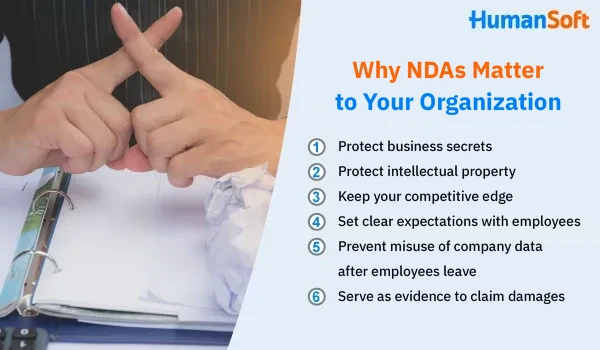
Why Do NDAs Matter to Organizations?
- Protect confidential business information: Reduce the risk of leaks involving business plans, customer data, or financial information.
- Protect intellectual property: Help prevent others from using secret formulas, innovations, and software still in development.
- Maintain a competitive advantage: Keep ideas and strategies from reaching competitors.
- Set clear expectations for the company and its employees: Both sides know which information they must keep confidential and for how long.
- Protect information after an employee resigns: The confidentiality obligation continues for the period specified in the agreement.
- Support claims for damages: If a dispute arises, the NDA serves as evidence that the parties agreed to maintain confidentiality.
What HR Should Know About NDAs
An NDA, or Non-Disclosure Agreement, is a confidentiality agreement. It may be unilateral, mutual, or multilateral, and it may have a fixed end date or no end date. A well-drafted NDA clearly defines confidential information, exceptions, duration, and the consequences of a breach. A party that breaches the agreement may have to pay damages or an agreed penalty, and an employee may face dismissal.
FAQ : Frequently Asked Questions About NDAs
Q : Can an employee refuse to sign an NDA?
A : Yes. Signing must be voluntary, but a company can make it a condition of employment or of access to confidential information.
Q : How does an NDA differ from a non-compete agreement?
A : An NDA bans sharing confidential information, while a non-compete bans working for a competitor for a set period. A court may enforce a non-compete only as far as it is fair.
Q : Does signing an NDA remove the need to comply with the PDPA?
A : No. The PDPA is a legal duty to protect personal data, and an NDA only adds extra protection. Read more in The PDPA and HR in the Workplace.
Q : Should freelancers or outsourcing companies sign an NDA?
A : Yes, before work begins. Company work rules do not cover them, so the NDA sets out their confidentiality duties.
Q : Should an NDA cover employee salary information?
A : Yes, HR and accounting staff who see salary data should sign an NDA or have a confidentiality clause in their contract. Read more in Why Is Employee Salary Information Confidential?
Related Articles
