

Thai Work Permit: What It Is, How to Apply and When to Renew
Work Permit, or work licence, is the document that the Department of Employment, Ministry of Labour, issues to foreigners so they can work legally in Thailand. The employer must apply for it before the employee starts work. A permit is valid for up to 2 years at a time and must be renewed before it expires. Employers who hire a foreigner without a permit face a fine of 10,000–100,000 baht per foreign worker.
Contents
- What Is a Work Permit?
- What Qualifications Do Foreigners Need for a Work Permit?
- What Are the Steps to Get a Work Permit?
- When Should a Work Permit Be Renewed?
- What Are the Penalties for Hiring a Foreigner Without a Work Permit?
- What Must HR Manage When Hiring Foreign Employees?
- How Can HR Software Help Manage Foreign Employees?
- FAQ: Common Questions About Work Permits
Table of Contents:
- Thai Work Permit: What It Is, How to Apply and When to Renew
- What Is a Work Permit?
- What Qualifications Do Foreigners Need for a Work Permit?
- What Are the Steps to Get a Work Permit?
- When Should a Work Permit Be Renewed?
- What Are the Penalties for Hiring a Foreigner Without a Work Permit?
- What Must HR Manage When Hiring Foreign Employees?
- How Can HR Software Help Manage Foreign Employees?
- FAQ: Common Questions About Work Permits
What Is a Work Permit?
A Work Permit is a licence that states what work a foreigner may do, for which employer and where. It is issued under the Royal Decree on Managing the Employment of Foreigners B.E. 2560 (2017) and its amendment of B.E. 2561 (2018). Foreigners working in Thailand need both a visa and a Work Permit, because the two documents serve different purposes.
|
Item |
Visa |
Work Permit |
|
Purpose |
Entering and staying in Thailand |
Working in Thailand |
|
Issued by |
Thai embassy or consulate, and the Immigration Bureau |
Department of Employment, Ministry of Labour |
|
Type used for work |
Non-Immigrant visa, usually Non-B |
States the job, employer and workplace |
|
Validity |
As permitted by Immigration |
Up to 2 years at a time |
What Qualifications Do Foreigners Need for a Work Permit?
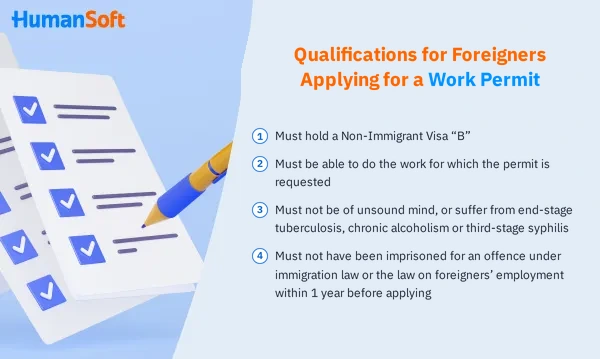
Foreigners applying for a work permit must meet these qualifications:
- Hold a Non-Immigrant visa, not a tourist visa
- Have the knowledge and skills for the job applied for
- Not suffer from a disease prohibited by law, such as leprosy, dangerous-stage tuberculosis, elephantiasis at a symptomatic stage, serious drug addiction or chronic alcoholism, as shown by a medical certificate submitted with the application
- Not have been sentenced to imprisonment for an offence under immigration law or the law on foreigners’ employment within 1 year before applying
- The job applied for must not be on the list of jobs prohibited for foreigners
A 2020 Ministry of Labour notification lists 40 jobs prohibited for foreigners. Some are completely banned and others are allowed under conditions, so HR should check the position before starting the hiring process.
What Are the Steps to Get a Work Permit?
The employer is responsible for applying for a work permit for a foreign employee. The general steps are:
- Check the position: make sure the job is not on the list of jobs prohibited for foreigners
- Get a visa: the foreigner applies for a Non-Immigrant visa at a Thai embassy or consulate, or changes visa type in Thailand under Immigration’s conditions
- Prepare documents: download the work permit application form from the Department of Employment website, then prepare a passport, visa, medical certificate, photos and the employer’s required documents
- Submit the application: at the Foreign Workers Administration Office (Bangkok), a provincial employment office, or the Department of Employment’s online channel
- Receive the permit: once approved, the employee may start work in the job, for the employer and at the location stated on the permit
|
Case |
What to do |
|
Never held a Work Permit |
Apply for a new work permit at the Department of Employment |
|
Held one, but it has expired |
Apply again, and stop working until a new permit is granted |
|
Holds one that is about to expire |
Apply for renewal before the permit expires |
When Should a Work Permit Be Renewed?
A renewal application must be submitted before the permit expires, ideally at least 30 days in advance. Renewals are granted for up to 2 years at a time, and the employee can keep working as normal while waiting for the decision.
If the application is rejected, the employee must stop working. If the employer still lets them work, the employer is committing the offence of employing a foreigner without a permit.
What Are the Penalties for Hiring a Foreigner Without a Work Permit?
Both foreign workers and employers face penalties under the Royal Decree on Managing the Employment of Foreigners.
|
Offender |
Penalty |
|
Foreigner working without a permit |
Fine of 5,000–50,000 baht and deportation |
|
Employer hiring a foreigner without a permit |
Fine of 10,000–100,000 baht per foreign worker |
|
Repeat-offending employer |
Up to 1 year in prison, or a fine of 50,000–200,000 baht per foreign worker, or both, plus a 3-year ban on hiring foreigners |
What Must HR Manage When Hiring Foreign Employees?
Besides applying for the permit, HR should manage the following throughout employment:
- Keep document copies: passport, visa and Work Permit, with their numbers and expiry dates
- Track expiry dates: for both the visa and the Work Permit, so renewals are filed on time
- Report hiring and resignations: notify the Department of Employment within 15 days of the employee starting or leaving work
- Report any changes: such as a new position, duties or workplace, which require approval first
- Payroll, tax and social security: foreign employees are subject to income tax withholding and social security contributions, just like Thai employees
How Can HR Software Help Manage Foreign Employees?
When employee data, documents and payroll are kept in one system, HR can see everything about foreign employees in one place. HumanSoft payroll software calculates salaries and deducts tax and social security for foreign employees in the same way as for Thai employees, while the online time attendance system supports employees who work at multiple locations.
See HumanSoft payroll software pricing or start a free 30-day trial
FAQ: Common Questions About Work Permits
Q: What is the difference between a Work Permit and a visa?
A: A visa is for entering and staying in Thailand and is issued by a Thai embassy or Immigration. A Work Permit is for working and is issued by the Department of Employment. Foreigners working in Thailand need both.
Q: How long is a Work Permit valid?
A: A work permit is valid for up to 2 years at a time and can be renewed for up to 2 years at a time. The renewal must be filed before the permit expires.
Q: Can an employee keep working while a Work Permit renewal is pending?
A: Yes, as long as the renewal was filed before the permit expired. If the application is rejected, the employee must stop working.
Q: Does a foreign employee who changes employer need a new Work Permit?
A: Yes. A Work Permit states the employer and workplace, so the new employer must apply for permission before the employee starts work.
Q: What is the penalty for hiring a foreigner without a Work Permit?
A: Employers face a fine of 10,000–100,000 baht per foreign worker. Repeat offences carry up to 1 year in prison or a fine of 50,000–200,000 baht per worker, plus a 3-year ban on hiring foreigners.
Q: Do foreign employees pay social security?
A: Yes. Foreign employees working for an employer in Thailand are insured under Section 33, just like Thai employees. 5% of wages is deducted, and the employer contributes the same amount.
Related articles


