

Understanding the HR Function and the Core Duties of HR
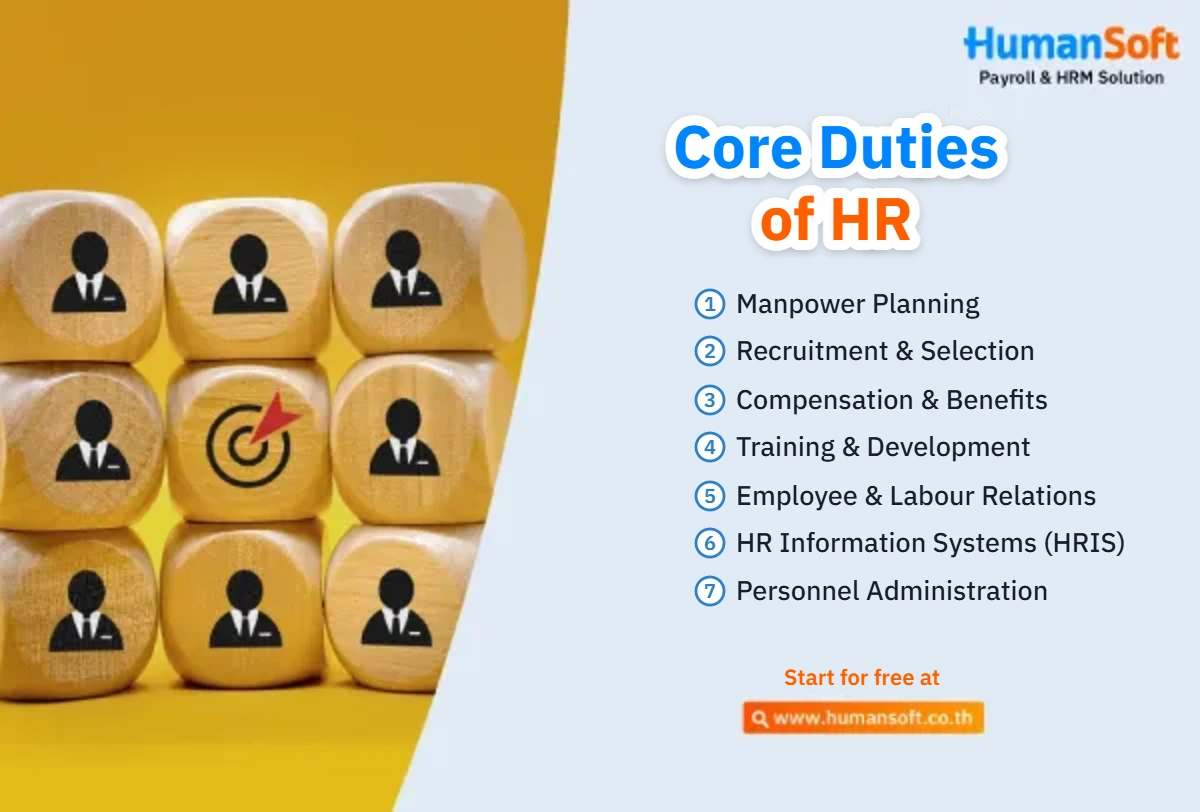
HR (Human Resources) has seven core duties: manpower planning, recruitment and selection, compensation and benefits, training and development, employee and labour relations, HR information systems, and personnel administration. HR today is no longer just about "hiring, firing, checking time cards and issuing warning letters". It is a business partner that looks after people throughout their entire working life cycle.
What Is the HR Function?
The HR function is the group of roles that manages an organisation's people, from planning how many employees are needed, hiring them and paying them, to developing them, maintaining discipline and handling employee records. Because people are the heart of any organisation, HR matters more today than ever before. HR now acts as a business partner, not simply the department that hires, fires, checks time cards and issues warning letters, as many outsiders still assume.
Work is changing faster than ever, driven by technology and economic conditions. Both organisations and employees must always be ready for change, and HR, which looks after the whole organisation, most of all. For the basics, read >>What Is HR? Roles, Responsibilities, and Key Qualities
What Are the Core Duties of Each HR Area?
1. Manpower Planning
Example job titles: Manpower Planning, HR Planning
Key responsibilities
- Analyse job roles (Job Analysis)
- Plan workforce needs to build the company structure (Organisation Chart): how many departments there are and how many employees each one needs
- Keep headcount aligned with and appropriate to the organisation's operations
2. Recruitment & Selection
Example job titles: Recruitment, Recruiter, HR Officer and, more recently, Talent Acquisition
Key responsibilities
- Receive requests for new or replacement employees (Manpower Request)
- Source candidates with the right knowledge, skills and qualifications, starting from a clear Job Description
- Post job vacancies (Job Posting)
- Coordinate and schedule job interviews (Job Interview)
- Prepare tools to assess candidates (Candidate)
- Communicate interview results and make job offers
- Prepare employment contracts, keep employee records, and onboard new hires into their departments
Do it in HumanSoft: The Recruitment system receives online job applications and manages candidates in one place.
3. Compensation & Benefits
Example job titles: Payroll, Payroll Management, Compensation & Benefits Officer, HR Welfare
Key responsibilities
- Calculate salaries, wages and other pay such as commission, overtime and housing allowance
- Plan and manage payroll
- Coordinate compensation and benefits such as bonuses, statutory holidays and leave, social security, health insurance, savings schemes and the Provident Fund
Do it in HumanSoft: Automated payroll, tax and social security calculation pulls approved working hours, overtime and leave into payroll, deducts withholding tax and social security under Thai law, and issues payslips that employees can view in the app.
4. Training & Development
Example job titles: HRD, HR Development, Training, Learning & Development, Performance Management
Key responsibilities
- Plan, source or design training courses, coordinate and run training
- Propose and manage programmes that build the knowledge, skills and attributes the organisation needs
- Design tools to test and measure employees' knowledge and abilities
- Plan and develop the Performance Management System (PMS), track and evaluate performance, and analyse employee development for management
To learn how to set performance indicators, read >>What Is a KPI? Measuring Business Performance
Do it in HumanSoft: The employee performance evaluation system lets HR create evaluation forms, set KPIs and schedule monthly, quarterly or annual review cycles, then summarise the results in instant reports.
5. Employee & Labour Relations
Example job titles: Labour Relations, Employee Relations, Grievance, Discipline
Key responsibilities
- Oversee company rules and employee discipline in line with labour law
- Draft the organisation's work rules and regulations
- Communicate and announce company rules and regulations
- Handle misconduct, investigations, mediation and disciplinary action
- Manage employee grievances and foster good relations between employees and the organisation, for example through sports days or Happy Workplace activities
6. Human Resource Information System (HRIS)
Job title: HRIS
Key responsibilities
- Design systems that support HR work
- Manage all HR databases
- Maintain and support the information systems
- Support reporting for management and study information systems that will affect the business in future
7. Personnel Administration
Example job titles: HR Admin, Personnel Administration
Key responsibilities
- Store and record employee registration data
- Process reimbursements and prepare expense documents
- Manage employment contracts and other related agreements
- Keep employee records such as work history, salary data, promotions and transfers
- Support employees and make their work easier
- Handle visa and work permit paperwork, and liaise with government agencies such as the Social Security Office and the Department of Skill Development
Do it in HumanSoft: The systems and paperwork in areas 6 and 7 can move into a single platform. Employees clock in by face scan, fingerprint, GPS or QR code; they request leave, overtime and certificates on their phones for managers to approve instantly; and HR can close the payroll cycle from the HumanSoft for HR app.
What Skills Does HR Need?
Good HR professionals need knowledge of labour law, communication skills, accuracy with numbers, the ability to keep information confidential, and confidence with technology.
|
Skill |
Where it is used |
|
Knowledge of labour and social security law |
Compensation, labour relations, personnel administration |
|
Communication and negotiation |
Recruitment, labour relations, training and development |
|
Accuracy and numeracy |
Payroll, tax, benefits |
|
Confidentiality and ethics |
Salary data, personal data (PDPA), disciplinary investigations |
|
Data analysis and HR systems |
Manpower planning, HRIS, management reporting |
To learn what HR needs to know about personal data, read >>What HR Needs to Know About PDPA: A Complete Guide
What Does a One-Person HR Team in a Small Company Need to Do?
A one-person HR team has to cover all seven areas, but should prioritise work with legal deadlines first: payroll, withholding tax, social security and employee registration. Development and performance evaluation can follow.
|
Frequency |
Main tasks for a one-person HR team |
|
Daily |
Check clock-in and clock-out times, approve leave, answer employee questions |
|
Every pay period |
Calculate salaries and overtime, deduct tax and social security, issue payslips |
|
Monthly |
File withholding tax returns, remit social security contributions, register new joiners and leavers |
|
Annually |
Run performance reviews, adjust salaries and bonuses, prepare annual tax summaries for employees |
The tasks repeated every day and every pay period are where an HR system saves the most time.
FAQ: Common Questions About HR Duties
Q: What does HR stand for?
A: HR stands for Human Resources. It refers to the department, or the people, who manage an organisation's employees.
Q: What are the core duties of HR?
A: There are seven: manpower planning, recruitment and selection, compensation and benefits, training and development, employee and labour relations, HR information systems, and personnel administration.
Q: What is the difference between HR and HRM?
A: HR usually refers to the people department or the people who work in it, while HRM (Human Resource Management) refers to the processes and strategies used to manage people across their whole life cycle.
Q: What HR job titles are there?
A: Examples include Recruiter or Talent Acquisition for hiring, Payroll or Compensation & Benefits Officer for pay, HRD or Learning & Development for training, Employee Relations for labour relations, HRIS for HR data systems, and HR Admin for personnel records.
Q: Can one HR person handle everything?
A: Yes. In small companies, one HR person often covers every area. Prioritise tasks with legal deadlines first, such as payroll, withholding tax and social security, and use an HR system to cut down on daily and per-period repetitive work.
Q: Which HR tasks can HR software help with?
A: It helps most with repetitive work such as time attendance, leave approval, payroll, tax and social security calculation, payslips, recruitment and performance evaluation. This frees HR to focus on strategic work such as employee development and labour relations.
Related articles
