

Q&A: Employer Pays Late. Can Employees Complain?
Yes. Employers must pay wages on the agreed date and at least once a month. Paying even one day late counts as a default, and the employer owes the employee interest of 15% per year from the due date. If the employer deliberately withholds payment for more than 7 days, a surcharge of 15% of the unpaid amount is added for every 7-day period.
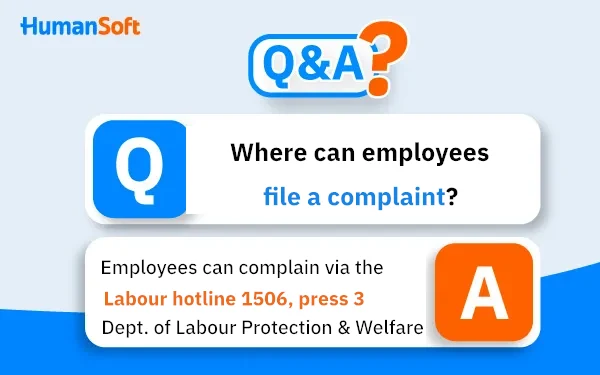
Employees can file a free complaint with a labour inspector using Form Kor Ror 7 (KR.7), or call the Ministry of Labour hotline 1506, press 3 (Department of Labour Protection and Welfare). No lawyer is needed, and no written employment contract is required to file.
Table of Contents:
- Q&A: Employer Pays Late. Can Employees Complain?
- How Many Days Late Can an Employer Pay Salary?
- What Does an Employer Owe for Paying Salary Late?
- Where Can Employees Report Unpaid Salary?
- What Do You Need to File Form KR.7, and How Long Until You Get Paid?
- Can You File a Complaint Without an Employment Contract?
- Can You Report Unpaid Salary to the Police or Sue in Court?
- How Can Employers and HR Prevent Late Salary Payments?
- Summary: Employer Pays Late. Can Employees Complain?
- Frequently Asked Questions
How Many Days Late Can an Employer Pay Salary?
Not a single day. The law gives employers no grace period for late payment. The correct payday is the date stated in the employment contract, the work rules, or the date the company normally pays. If wages are still unpaid after that date, the employer is in default immediately.
Section 70 of the Labour Protection Act B.E. 2541 (1998) sets the following time frames:
- Wages (monthly, daily, hourly or piece-rate) must be paid at least once a month, unless both sides agree on terms that are more favourable to the employee.
- Overtime pay, holiday work pay and holiday overtime pay must be paid at least once a month.
- On termination, the employer must pay everything the employee is entitled to within 3 days of the termination date.
Example: A company pays salaries on the 25th of each month, but the money arrives on the 30th. That is 5 days late, so the employee is entitled to interest for those 5 days and can file a complaint. To see which payments count as wages, read more: Payments that count as wages under Thai labour law
What Does an Employer Owe for Paying Salary Late?
Under Section 9, a late-paying employer owes two separate amounts: interest, which applies to every late payment, and a surcharge, which applies only when payment is deliberately withheld for more than 7 days. The conditions differ, as shown below.
| Item | Interest (Section 9, paragraph 1) | Surcharge (Section 9, paragraph 2) |
|---|---|---|
| When it applies | Every time payment is later than the due date | The employer deliberately withholds payment without reasonable cause |
| Rate | 15% per year of the unpaid amount | 15% of the unpaid amount for every 7-day period |
| Starts counting | From the due date | Once 7 days have passed since the due date |
| Must intent be proven? | No | Yes |
Example: The monthly salary is 15,000 baht and the employer pays 30 days late. The interest owed = 15,000 × 15% × 30 ÷ 365 ≈ 184.93 baht. If the employer withheld payment deliberately, the surcharge under paragraph 2 is owed on top of this.
If the employer is ready to pay and deposits the money with the Director-General of the Department of Labour Protection and Welfare (or a person assigned by the Director-General) for payment to the employee, interest and surcharge stop accruing from the date of the deposit.
Text of Section 9, Labour Protection Act B.E. 2541 (1998) (unofficial translation)
"Where an employer fails to return a guarantee deposit under Section 10, paragraph two, or fails to pay wages, overtime pay, holiday work pay and holiday overtime pay within the time specified in Section 70, or severance pay under Section 118, or special severance pay under Sections 120, 121 and 122, the employer shall pay the employee interest at the rate of fifteen percent per year during the period of default.
Where the employer deliberately fails to return or pay the money under paragraph one without reasonable cause after seven days from the date it falls due, the employer shall pay the employee a surcharge of fifteen percent of the outstanding amount for every period of seven days.
Where the employer is ready to return or pay the money under paragraphs one and two and has deposited it with the Director-General or a person assigned by the Director-General for payment to the employee, the employer shall not be liable for interest or surcharge from the date of such deposit."
Where Can Employees Report Unpaid Salary?
Employees can report to the Department of Labour Protection and Welfare in person, online, or through hotline 1506, press 3. All channels are free of charge.
- File in person: Submit Form KR.7 to a labour inspector at the Labour Protection and Welfare office in the area where the employee works, or where the employer is domiciled.
- Report online: Go to the Department of Labour Protection and Welfare website www.labour.go.th and choose the "Contact Us" menu.
- Ministry of Labour hotline: 1506, press 3 (Department of Labour Protection and Welfare).
- Department of Labour Protection and Welfare hotline: 1546, during official working days and hours.
- LINE Official Account: @prdlpw
If you want an official order requiring the employer to pay, file Form KR.7, because it follows a legal procedure with set deadlines. The hotlines are best for checking your rights before you file.
What Do You Need to File Form KR.7, and How Long Until You Get Paid?
The labour inspector must issue an order within 60 days of receiving the complaint, extendable by no more than 30 days. The law sets a deadline for the order, not for when money reaches your account. You get paid once the employer complies with the order, so the more complete your evidence, the faster the case moves.
Documents and evidence to prepare
- The employee's national ID card
- Proof of employment, such as an employment contract, employment certificate, staff ID card or previous payslips
- Proof of working days and the amount owed, such as clock-in and clock-out records, bank deposit records, and chats or emails about salary
- The employer's or company's name, workplace address and phone number
What happens after you file
- The employee submits Form KR.7 with supporting evidence.
- The labour inspector investigates and calls both the employer and the employee to give information.
- The labour inspector issues an order within 60 days (extendable by no more than 30 days). If the employee is found to be entitled, the employer is ordered to pay the outstanding amount.
- Either side that disagrees with the order may take the case to the Labour Court within 30 days of learning of the order. If no case is filed in time, the order becomes final.
Can You File a Complaint Without an Employment Contract?
Yes. An employment contract does not have to be in writing, and a verbal agreement is legally binding. What you need is evidence that you actually worked for the employer and the agreed pay, such as chats arranging your start date, records of earlier salary transfers, photos taken at work, or co-workers who can act as witnesses.
Read more: Q&A: Is a verbal employment contract legally binding?
Can You Report Unpaid Salary to the Police or Sue in Court?
Both are possible. Failing to pay wages on time under Section 70 is a criminal offence under Section 144, punishable by up to 6 months in prison, a fine of up to 100,000 baht, or both. But if your goal is to get your money back, the most direct routes are filing Form KR.7 or suing for the money in the Labour Court.
- Suing in the Labour Court: Employees can file on their own, with no court fees and no need for a lawyer.
- Statute of limitations: Claims for wages must be made within 2 years, so do not wait too long.
Read more: 10 labour cases employers are likely to lose in court
How Can Employers and HR Prevent Late Salary Payments?
The best approach is to close the payroll cycle several days before payday. If late payment cannot be avoided, notify employees in writing in advance and give the new payment date. Advance notice helps maintain trust, but it does not cancel the interest owed under Section 9.
- Close attendance, overtime and leave records at least 3–5 working days before payday, leaving time to review and send the transfer file to the bank.
- Use an automatic payroll calculation program that pulls data from an online time attendance system to reduce manual entry and the errors that delay payday.
- If you are ready to pay but cannot reach the employee, deposit the money with the Department of Labour Protection and Welfare to stop interest and surcharge from accruing.
Read more: Is paying salaries late illegal? What business owners should know
Summary: Employer Pays Late. Can Employees Complain?
Employers must pay wages on the agreed date and at least once a month. Paying even one day late means owing interest of 15% per year, and deliberately withholding payment for more than 7 days adds a surcharge of 15% for every 7 days. Employees can file a free complaint with Form KR.7, report online at www.labour.go.th, or call 1506, press 3, even without a written employment contract. Keep complete evidence of your work and the amount owed, and file within the 2-year statute of limitations.
Frequently Asked Questions
Q: Is it illegal for a company to pay salary 5 days late?
A: Yes. Section 70 requires payment on the agreed schedule. The company owes interest of 15% per year for the 5 late days. For a salary of 15,000 baht, that is about 30.82 baht. The 15% surcharge does not apply yet, because the delay is under 7 days.
Q: After reporting unpaid wages to the labour department, how long until I get paid?
A: The labour inspector must issue an order within 60 days of receiving the complaint, extendable by no more than 30 days. You get paid once the employer complies with the order. If the employer disagrees with the order, it must sue in the Labour Court within 30 days.
Q: Does it cost anything to file a complaint about unpaid salary?
A: No. Filing Form KR.7, reporting online and suing in the Labour Court are all free of fees. Employees can handle the process themselves without hiring a lawyer.
Q: Can I still claim unpaid salary after resigning?
A: Yes. Your right to claim wages does not end when you resign. You can file a complaint or sue within the 2-year statute of limitations. Keep your payslips, bank deposit records and proof of working days.
Q: Can I file a complaint if my employer pays only part of my salary?
A: Yes. The unpaid portion counts as outstanding wages, and the employer owes interest on it as well. Use the same channels: Form KR.7 or hotline 1506, press 3.
Related Articles
