
Is It Illegal for an Employer Not to Pay Overtime, and What Can Employees Do?
Failure to pay overtime (OT) is a violation of Thai labour law. Employees who work overtime are entitled to compensation of no less than 1.5 times their hourly wage under the Labour Protection Act B.E. 2541 (1998). Employers who fail to comply may face legal penalties, and employees may file a complaint with the Department of Labour Protection and Welfare.
Q: Is it illegal for a company not to pay employees overtime?
The company’s normal working hours are 8:00 a.m. to 5:00 p.m. Because the workload exceeds the number of employees available, the company asks employees to work for one additional hour, from 5:00 p.m. to 6:00 p.m., without overtime pay. Is the company allowed to do this, and is it illegal?
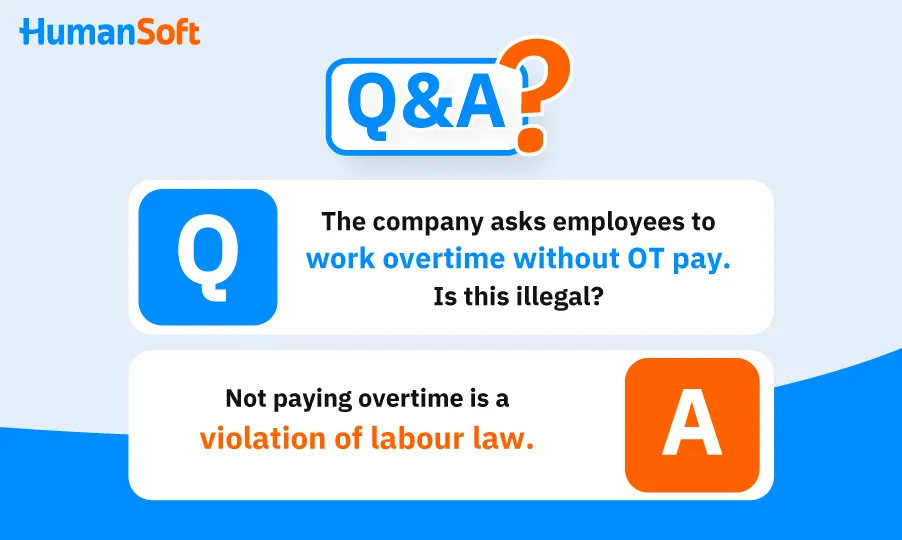
A: An employer who does not pay overtime is violating labour law.
Employees who work overtime are entitled to overtime compensation based on the actual hours worked under the Labour Protection Act B.E. 2541 (1998). For overtime on a normal working day, the employer must pay no less than 1.5 times the employee’s normal hourly wage.
Therefore, if an employer does not pay overtime (OT) or overtime compensation to employees, this is a violation of labour law. Under the Labour Protection Act B.E. 2541 (1998), the employer may faceimprisonment for up to 6 months, a fine of up to THB 100,000, or both.
Q: What must an employer do when requiring employees to work overtime?
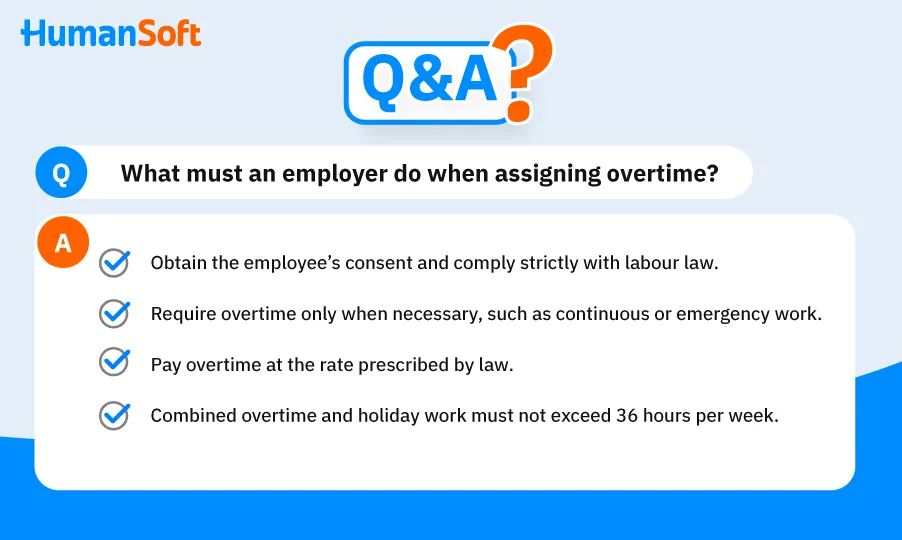
A: Overtime requires employee consent and strict compliance with labour law.
When an employer wants an employee to work overtime, the employer must comply strictly withthe Labour Protection Actas follows:
- An employer may ask an employee to work overtime, but the employee’s consent must be obtained on each occasion.
- An employer may require overtime only as necessary when the nature or condition of the work requires continuity, when stopping would cause damage, or in an emergency.
- When overtime is worked, the employer must pay overtime compensation at the rate prescribed by labour law.
- Combined overtime, holiday work, and overtime on holidays must not exceed 36 hours per week.
If an employee is required to work overtime for at least 2 hours immediately after normal working hours, the employer must provide a break of at least 20 minutes before overtime begins.
In addition to understanding legal rights, knowinghow to calculate overtime on working days and holidayswill help employees verify their pay more accurately.
Summary: Is It Illegal to Require Overtime Without Paying OT?
When an employer requires an employee to work beyond normal working hours, the employee’s consent must be obtained and overtime must be paid at the legally prescribed rate. Failure to comply violates the Labour Protection Act B.E. 2541 (1998) and may result in legal action.
Employers should comply strictly with overtime laws to avoid complaints, investigations, or legal proceedings.
FAQ: Employers Who Do Not Pay Overtime
Q: Is it illegal for an employer not to pay overtime?
Q: What should an employee do if overtime is not paid?
Q: Must overtime be paid if the employer did not give advance notice?
Q: Can an employee sign an agreement waiving the right to overtime pay?
Read More Related Articles:
- Q&A: Must Employees Receive a 20-Minute Break Before Overtime?
- What Is 1.5x Overtime Pay and How Is It Calculated?
- Meet Every Business Need with Overtime Calculation Features
- How to Calculate Daily and Monthly Overtime Under Thai Labour Regulations
- Make Overtime Calculation Easier with OT Calculation Software