

What Is the Workmen’s Compensation Fund? Who Must Pay?
The Workmen’s Compensation Fund is administered by the Social Security Office. It pays medical expenses, compensation, rehabilitation costs, and funeral expenses on behalf of employers when employees suffer work-related illness. Only employers contribute to the fund.
Table of Contents:
- What Is the Workmen’s Compensation Fund? Who Must Pay?
- What Is the Workmen’s Compensation Fund?
- What Benefits Can Employees Receive from the Workmen’s Compensation Fund?
- Which Employers Must Contribute?
- How Much Must Employers Contribute and When Are Payments Due?
- How Does the Workmen’s Compensation Fund Differ from the Social Security Fund?
- What the Workmen’s Compensation Fund Covers and Who Pays
- Frequently Asked Questions About the Workmen’s Compensation Fund
What Is the Workmen’s Compensation Fund?
The Workmen’s Compensation Fund was established under the Workmen’s Compensation Act B.E. 2537 (1994), as amended by Act No. 2 B.E. 2561 (2018). The Social Security Office administers the fund, which pays compensation on behalf of employers when employees are injured, become ill or disabled, die, or go missing as a result of their work.
The fund is financed by annual employer contributions, which work much like premiums for occupational accident insurance. When an incident occurs, the fund supports employees directly and protects employers from having to bear large expenses themselves.
- Coverage applies to incidents arising from work, carrying out an employer’s instructions, or protecting the employer’s interests.
- Coverage applies regardless of where or when the incident occurs, as long as it is work-related.
- Employers alone pay contributions.
What Benefits Can Employees Receive from the Workmen’s Compensation Fund?
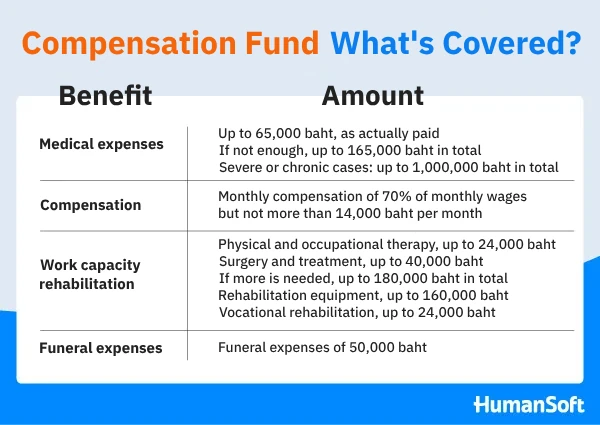
Employees who suffer a work-related injury or illness are eligible for four types of benefits. The table below summarizes the amounts payable.
| Benefit | Amount Payable |
|---|---|
| Medical expenses | Actual expenses up to THB 65,000. For severe or chronic injuries, the limit is THB 150,000, with an overall maximum of THB 1,000,000. |
| Monthly compensation | 70% of monthly wages, up to THB 14,000 per month, based on wages capped at THB 20,000. |
| Occupational rehabilitation expenses | Payment depends on the type of rehabilitation, including medical and vocational rehabilitation. |
| Funeral expenses | THB 50,000 is paid to the person responsible for arranging the funeral. |
Medical Expenses
For each work-related injury or illness, the fund covers necessary medical expenses up to THB 65,000. For severe or chronic injuries that meet the legal criteria, the limit can increase in stages to a total of THB 1,000,000.
If you are unsure whether an incident qualifies for fund benefits or sick leave, see Should Employees Injured at Work Take Sick Leave or Claim Workmen’s Compensation?
Monthly Compensation in Four Cases
| Case | Rate | Payment Period |
|---|---|---|
| Doctor-ordered absence from work to recover | 70% of monthly wages | From the first day of absence, up to one year in total |
| Loss of physical function | 70% of monthly wages | Up to 10 years, depending on the type of loss |
| Disability | 70% of monthly wages | For life |
| Death or disappearance | 70% of monthly wages | 10 years, paid to eligible beneficiaries |
Occupational Rehabilitation Expenses
- Physical therapy and occupational therapy are reimbursed at actual cost up to THB 24,000.
- Surgery and treatment are covered up to THB 40,000. Additional expenses may be covered when necessary, up to THB 180,000 in total.
- Rehabilitation supplies and equipment are covered at rates set by the Ministry of Finance, up to THB 160,000 in total.
- Vocational rehabilitation is covered up to THB 24,000.
Which Employers Must Contribute?
Employers in all sectors nationwide with at least one employee must register and contribute under the Workmen’s Compensation Act B.E. 2537 (1994), as amended. Act No. 2 B.E. 2561 (2018) extended coverage to employees of nonprofit organizations and to government employees other than civil servants and permanent employees.
Employers Exempt from the Workmen’s Compensation Act

- Central, provincial, and local government agencies, with the exemption applying only to civil servants and permanent employees
- State enterprises governed by state enterprise labor relations law
- Foreign governments and international organizations
- Other employers exempt under the law
How Much Must Employers Contribute and When Are Payments Due?
Contributions are calculated by multiplying the total annual wages of all employees by the contribution rate for the business category. Rates range from 0.2% to 1.0%, depending on occupational risk. The wage base is capped at THB 240,000 per employee per year.
Contribution = Total annual wages (capped at THB 240,000 per employee) × the applicable contribution rate
Suppose a company has 10 employees who each earn THB 15,000 per month, and its contribution rate is 0.2%. Total annual wages are 15,000 × 12 × 10 = THB 1,800,000. The annual contribution is 1,800,000 × 0.2% = THB 3,600.
| Employer Obligation | Deadline |
|---|---|
| Pay the annual contribution based on estimated wages for the year | 31 January each year |
| Report actual wages paid in the previous year using Form KT.20 Kor | 28 February |
| Pay any shortfall identified after reporting actual wages | 31 March |
For more details on calculating contributions, see Workmen’s Compensation Fund Q&A on How Much Employers Pay and How to Pay. For instructions on filing Form KT.20 Kor online, see What Is Form KT.20 Kor and How Do You File It via e-Wage?
How Does the Workmen’s Compensation Fund Differ from the Social Security Fund?
The Social Security Office administers both funds. Each covers different situations and has its own contribution rules.
| Comparison | Workmen’s Compensation Fund | Social Security Fund (Section 33) |
|---|---|---|
| Coverage | Work-related injury, illness, disability, or death | Non-work-related illness or death, plus maternity, child allowance, unemployment, and old-age benefits |
| Who Contributes | Employers only | Employers, employees, and the government |
| Contribution Rate | 0.2%–1.0% of wages, depending on the risk associated with the business | Employers and employees each contribute 5% of wages within the statutory wage base |
| Payment Frequency | Annually | Monthly |
| Governing Law | Workmen’s Compensation Act B.E. 2537 (1994) | Social Security Act B.E. 2533 (1990) |
For a comparison of coverage under each section, see How Do Social Security Sections 33, 39, and 40 Differ?
What the Workmen’s Compensation Fund Covers and Who Pays
The fund protects employees who suffer work-related injury, illness, disability, or death. It pays medical expenses, compensation, rehabilitation costs, and funeral expenses on behalf of employers. Employers with at least one employee pay the full annual contribution by 31 January. Exemptions apply to government agencies, state enterprises, and international organizations as specified by law.
Frequently Asked Questions About the Workmen’s Compensation Fund
Are probationary and part-time employees covered?
Yes. Coverage starts on the first day of employment. The law protects employees regardless of their contract type or length of service.
Are foreign workers covered?
Yes. They receive the same coverage as Thai employees. Employers must include foreign employees’ wages when calculating contributions.
When must an employer register with the Workmen’s Compensation Fund?
Employers must register within 30 days of hiring their first employee. They can register with the fund and social security at the same time.
Will employees continue receiving compensation if they resign?
Yes. Compensation continues for the full period of entitlement even after employment ends.
Where can employers find their contribution rate?
Employers can check the annual contribution notice from the Social Security Office or contact the local office where their business is registered.
Related Articles
- A Guide to Workmen’s Compensation Fund Forms KT.26 Kor, KT.20 Kor, and KT.25 Khor
- How Employers Can Report a Work-Related Injury via E-Compensate
- What Should HR Do When an Employee Is Injured at Work?
- Which Employee Earnings Should Employers Report for Social Security?
- Why Social Security Contributions Matter and How to Submit Them
