

Income and Expense Records: Revenue Department Requirements and a Free Template
An income and expense record, referred to by Thailand's Revenue Department as a "cash receipts and payments report", records the money a business receives and pays out each day. It helps determine monthly profit or loss and supports actual expense deductions when filing personal income tax. A report accepted by the Revenue Department must include at least six columns, be prepared in Thai and be updated within three days of each receipt or payment.
Table of Contents:
- Income and Expense Records: Revenue Department Requirements and a Free Template
- What Is an Income and Expense Record, and Who Needs One?
- Income and Expense Record Basics for New Business Owners
- Income and Expense Records in the Revenue Department Format
- Summary: Income and Expense Records for New Business Owners
- FAQ: Frequently Asked Questions About Income and Expense Records
What Is an Income and Expense Record, and Who Needs One?
Income and expense records are suitable for individual business owners or unregistered ordinary partnerships, such as online shops, small restaurants and freelancers, that wish to deduct actual expenses instead of claiming a standard deduction. Limited companies and registered juristic partnerships must maintain full accounting records under accounting law; an income and expense record cannot replace them.
| Type of Business Owner | Required Records |
|---|---|
| Individuals (shop owners, freelancers and online sellers) who claim actual expense deductions | Prepare a cash receipts and payments report in the Revenue Department format and retain all supporting documents. |
| Individuals who claim a standard expense deduction | Not mandatory, but recommended for tracking business profit and loss. |
| Limited companies / juristic partnerships | Maintain full accounting records under the Accounting Act B.E. 2543 (2000). |
Income and Expense Record Basics for New Business Owners
The Revenue Department specifies a format for income and expense records. New business owners can follow these guidelines.
1. Create an Income and Expense Report
The report must include the entries and information required by the Revenue Department's prescribed format.
2. Prepare the Record in Thai
Business owners must prepare their income and expense records in Thai. If another language is used, a Thai translation must accompany it.
3. Record Transactions Within Three Days
Record income and expense transactions within three working days of receiving or paying money to prevent discrepancies.
4. Include Transaction Details in the Report
- Keep supporting documents for each report entry, such as receipts or tax invoices.
- Expenses entered in the report must relate directly to the business.
- You may record the total income and expenses for each working day, supported by documents, or record individual transactions in detail.
- If the business is not registered for value-added tax (VAT), tax paid on expenses may be included in the cost of goods.
- For credit transactions involving sales, services, purchases or other expenses, where payment is deferred, record the transaction on the date goods or services are received or supplied and add details in the “Remarks” column.
5. Summarise Income and Expenses Monthly
Prepare monthly income and expense totals as supporting evidence for personal income tax filing.
Individual business owners must file a half-year personal income tax return (P.N.D. 94) or an annual personal income tax return (P.N.D. 90). Income and expense records can be used to report assessable business income and claim actual expense deductions.
Income and Expense Records in the Revenue Department Format
A cash receipts and payments report, or income and expense record, must include the fields prescribed by the Revenue Department, as follows:
1. “Date” Column:
Record the day, month and year of each income or expense transaction.
2. “Description” Column:
Record transaction details, such as purchases, water bills or service charges.
3. “Income” Column:
Record the amount received for the transaction described in the “Description” column.
4. “Expenses (Purchases)” Column:
Record amounts paid for goods or services directly related to the business.
5. “Expenses (Other Expenses)” Column:
Record other business-related expenses, such as transport costs.
6. “Remarks” Column:
Add details of credit sales, purchases or other expenses. Record these transactions on the date the goods are received or supplied.
Business owners may add columns beyond those required by the Revenue Department as appropriate for their business needs.
Note: A cash receipts and payments report is a record showing income and expenses.
Income and Expense Record Example
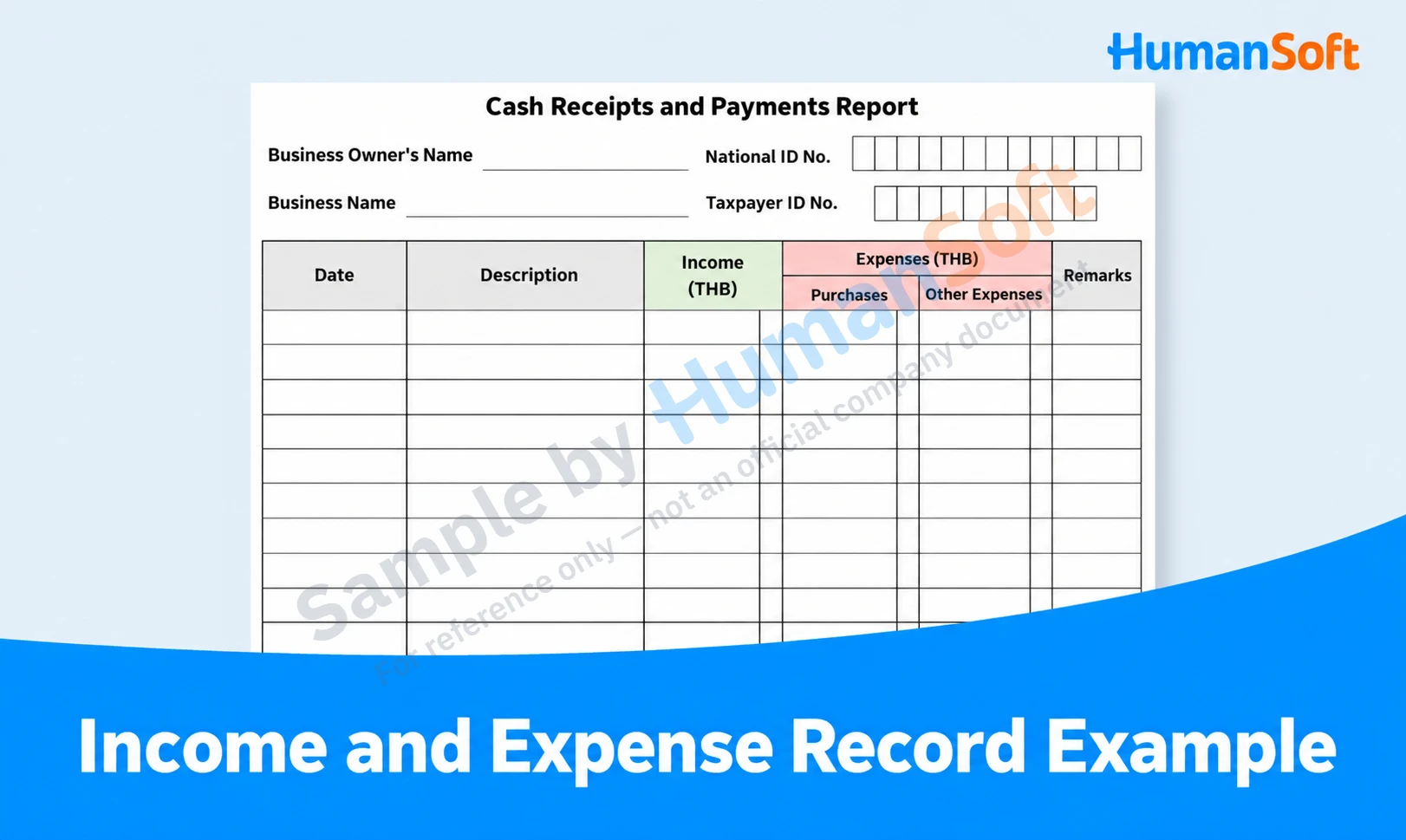
Tips! Download the template: Income and Expense Record
Summary: Income and Expense Records for New Business Owners
Starting a business requires careful research and planning. Keeping income and expense records is also essential: it helps you understand the business's financial position, assess its liquidity and determine whether performance meets expectations. These records also support effective business planning.
FAQ: Frequently Asked Questions About Income and Expense Records
Q: Can I keep my own income and expense records and claim actual expenses when filing tax?
A: Yes. Individuals, such as online shop owners and freelancers, may choose to deduct actual expenses. However, they must prepare a cash receipts and payments report in the Revenue Department's required format and retain every receipt as evidence so the amounts can be verified.
Q: How should I record VAT on purchases if my business is not VAT-registered?
A: If your business is not VAT-registered and a raw material purchase includes 7% VAT, include that VAT in the cost of goods or expenses. You do not need a separate input VAT column as VAT-registered companies do.
Q: How long should I keep receipts and income and expense reports?
A: Revenue Department requirements state that employers or business owners must retain supporting accounting documents and cash receipts and payments reports for at least five years from the tax return filing date to support retrospective inspections.
Read Related Articles:
