
How to Calculate Overtime for Monthly and Daily Employees Under Thai Labour Law
Overtime (OT) means working beyond normal working hours. Employers must pay additional compensation at the rates prescribed by law, ranging from 1.5 to 3 times the hourly wage, depending on the type of day and the employee category. OT is calculated as (hourly wage) × (OT rate) × (number of OT hours). The rate is 1.5 times for overtime on a normal workday. For work performed on a holiday,monthly employees receive 1 time / daily employees receive 2 times and overtime performed on a holiday is paid at 3 times the hourly wage, in accordance with Sections 61–63 of the Labour Protection Act B.E. 2541 (1998).
Example: A monthly employee earning THB 15,000 works 4 hours of overtime on a normal workday = (15,000 ÷ 30 ÷ 8) × 1.5 × 4 = THB 375.
This article covers all major OT calculation formulas with practical examples for both daily and monthly employees, based on Sections 61–63 of the Labour Protection Act B.E. 2541 (1998).
Table of Contents:
- How to Calculate Overtime for Monthly and Daily Employees Under Thai Labour Law
- What Is Overtime (OT) Under Thai Labour Regulations?
- How to Calculate OT for Monthly and Daily Employees
- How Is OT Calculated on Holidays? What Rate Applies?
- How Many Overtime Hours Can Employees Work per Week?
- What OT Rates Apply to Monthly and Daily Employees?
- Is There an Automatic OT Calculation Program?
- FAQ: Frequently Asked Questions About OT Calculation
What Is Overtime (OT) Under Thai Labour Regulations?
OT, short for Overtime, is additional compensation employees receive for working beyond normal working hours, such as continuing to work after the end of a shift or working on a holiday. OT calculationunder Thai labour law follows these principles:
- OT calculation formula: OT pay = (hourly wage) × (OT rate) × (number of OT hours)
- Legal principle: Employers may require overtime work only when necessary and must obtain the employee’s consent beforehand.
- Exceptions where prior consent is not required: This includes work that must be performed continuously because stopping would cause damage, or emergency work, such as certain hotel, entertainment venue, transportation, club or association, and healthcare operations, where prior employee consent is not required.
How to Calculate OT for Monthly and Daily Employees
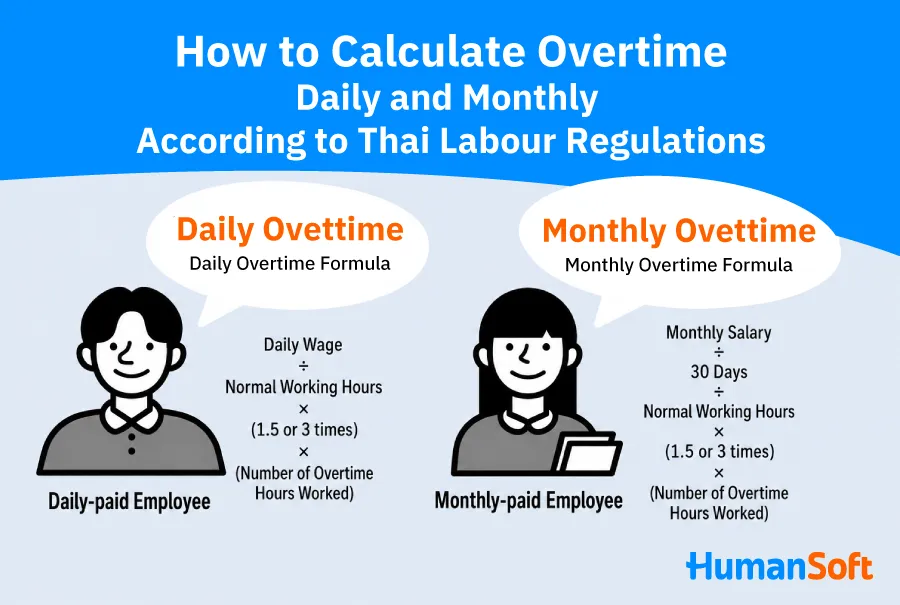
The following OT calculations for employees are based on Sections 61–63 of the Labour Protection Act B.E. 2541 (1998) [Labour Protection Act]. OT for daily and monthly employees can be calculated as follows:
How to Calculate OT for Monthly Employees
To calculate OT for a monthly employee, first determine the hourly wage, then multiply it by the OT rate and the number of OT hours. There are 3 steps:
- Calculate the daily wage: Divide the monthly salary by 30 days.
- Calculate the hourly wage : Divide the daily wage by the normal working hours per day (normally 8 hours).
- Multiply by the OT rate and number of hours : Hourly wage × OT rate × number of OT hours.
Formula: (Monthly salary ÷ 30 ÷ normal working hours) × OT rate × number of OT hours
Example: A monthly employee earns THB 20,000, works 8 normal hours per day, and works 3 hours of OT on a normal workday (1.5× rate).
(20,000 ÷ 30 ÷ 8) × 1.5 × 3 = THB 375
How to Calculate OT for Daily Employees
To calculate OT for a daily employee, first determine the hourly wage, then multiply it by the OT rate and the number of OT hours. There are 2 steps:
- Calculate the hourly wage : Divide the daily wage by the normal working hours per day (normally 8 hours).
- Multiply by the OT rate and number of hours : Hourly wage × OT rate × number of OT hours.
Formula: (Daily wage ÷ normal working hours) × OT rate × number of OT hours
Example: A daily employee earns THB 500 per day, works 8 normal hours per day, and works 3 hours of OT on a normal workday (1.5× rate).
(500 ÷ 8) × 1.5 × 3 = THB 281.25
Learn more about statutory overtime rights at
How Is OT Calculated on Holidays? What Rate Applies?
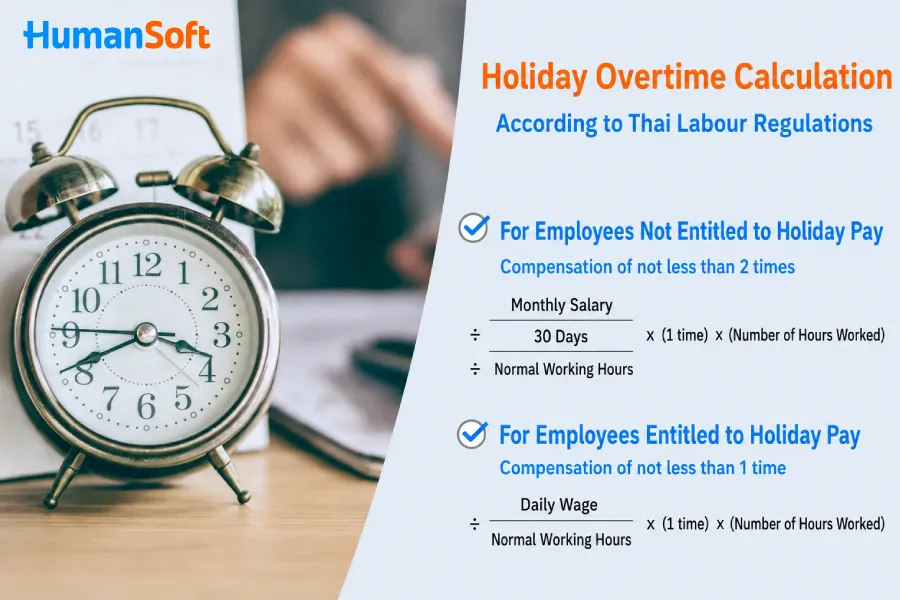
For work performed during normal working hours on a holiday, monthly employees receive 1 time the hourly wage, while daily employees receive 2 times the hourly wage. The calculation for public holidays and other holidays is as follows:
1. How to Calculate Holiday Pay for Employees Entitled to Holiday Wages
Employees who are entitled to wages on holidays, such as monthly employees, must receive at least 1 time their hourly wage for working during their holiday.
• OT calculation formula: (Monthly salary ÷ 30 days ÷ normal working hours) × (1 time) × (number of hours worked)
• Calculation: (20,000 ÷ 30 ÷ 8) X 1 X 8)
• Additional OT pay received for that day = THB 667
2. How to Calculate Holiday Pay for Employees Not Entitled to Holiday Wages
Employees such as daily employees receive at least 2 times their hourly wage for working during their holiday.
• OT calculation formula: (Daily wage ÷ normal working hours) × (2 times) × (number of hours worked)
• Calculation: (400 ÷ 8) X 2 X 8)
• Additional OT pay received for that day = THB 800
How Many Overtime Hours Can Employees Work per Week?
Thai labour law sets normal working hours and the maximum OT limit as follows:
| Employee Type | Normal Working Hours/Day | Normal Hours/Week | Maximum OT/Week |
|---|---|---|---|
| General Employees | No more than 8 hrs. | No more than 48 hrs. | No more than 36 hrs. |
| Employees in Hazardous Work | No more than 7 hrs. | No more than 42 hrs. | No more than 36 hrs. |
Within one working day, employees must receive a rest period of at least 1 hour after working continuously for no more than 5 hours. The rest period may be divided into separate intervals or arranged by agreement between the employer and employee. For weekly holidays, employees must have at least 2 days off per week, with no more than 6 days between holidays.
Reference: Sections 23–24 of the Labour Protection Act B.E. 2541
What OT Rates Apply to Monthly and Daily Employees?
Thai labour law provides 3 OT or holiday-work rate scenarios, depending on the type of day and whether the employee is paid monthly or daily, as shown below.
| Scenario | Monthly Employees | Daily Employees | Legal Reference |
|---|---|---|---|
| Overtime on a normal workday | 1.5 times | 1.5 times | Section 61 |
| Work on a holiday (during normal working hours) | 1 time | 2 times | Section 62 |
| Overtime on a holiday | 3 times | 3 times | Section 63 |
All rates are calculated from the employee’s hourly wage and represent the legal minimum. Employers may pay higher rates.
Tips! Read more >> Don’t Miss: Labour Laws Every Employee Should Know
Is There an Automatic OT Calculation Program?
For organizations with multiple employee types, shifts, or OT rates, calculating overtime in Excel can be prone to errors, especially when normal workdays, holidays, and public holidays must be calculated together. Using payroll software to calculate OT can make the process easier, more accurate, and more reliable within a single tool. payroll software HumanSoft is one of the systems chosen by many organizations.
- Reduce work steps for the accounting team.
- Improve convenience for teams across the organization.
- Support flexible working arrangements.
- Easily adjust settings to suit your business.
- Configure OT payments, daily wages, monthly salaries, andtaxother payment settings for faster and more convenient payroll processing.
View details on the Payroll Calculation page
Calculating overtime manually every month is time-consuming and prone to errors. With HumanSoft, employees can request OT via mobile, managers can approve it instantly, and the system automatically calculates overtime hours. Learn more at HumanSoft App for HR: Manage HR Anywhere
FAQ: Frequently Asked Questions About OT Calculation
Q: What is the maximum number of OT hours per week?
A: Employers may have employees work overtime together with holiday work, but the total must not exceed 36 hours per week to prevent excessive working hours.
Q: Can an employer force an employee to work overtime?
A: No. If an employer wants an employee to work overtime or on a holiday, the employee’s consent must generally be obtained on each occasion, except for work that must be performed continuously and would be damaged if interrupted.
Q: How much should a daily employee receive for working on a holiday during normal working hours?
A: 2 times the hourly wage. Because daily employees do not receive wages for holidays, they must receive 2 times the hourly wage when they work on a holiday.
Q: How much additional pay does a monthly employee receive for working on a holiday during normal working hours?
A: An additional 1 time the hourly wage. Under the law, monthly employees already receive their regular holiday wage, so working on the holiday adds another 1 time the hourly wage.
Q: Is OT pay subject to personal income tax?
A: Yes. OT pay is considered income under Section 40(1) of the Revenue Code and must be combined with salary when calculating annual personal income tax. If the company withholds tax at source, OT pay is included in that tax base.
Q: Are probationary employees entitled to OT pay?
A: Yes. Probationary employees are protected under the Labour Protection Act B.E. 2541 (1998) in the same way as regular employees. Employers must pay OT at the statutory rate from the employee’s first day of work.
Q: What can employees do if an employer does not pay OT?
A: Employees can file a complaint with their local Labour Protection and Welfare Office or call the Department of Labour Protection and Welfare hotline at 1546 free of charge. Employers who violate the law may be subject to penalties under Section 144 of the Labour Protection Act B.E. 2541 (1998).
Related Articles You May Be Interested In: