
How Many Days of Annual, Sick, and Personal Leave Are Allowed by Law?
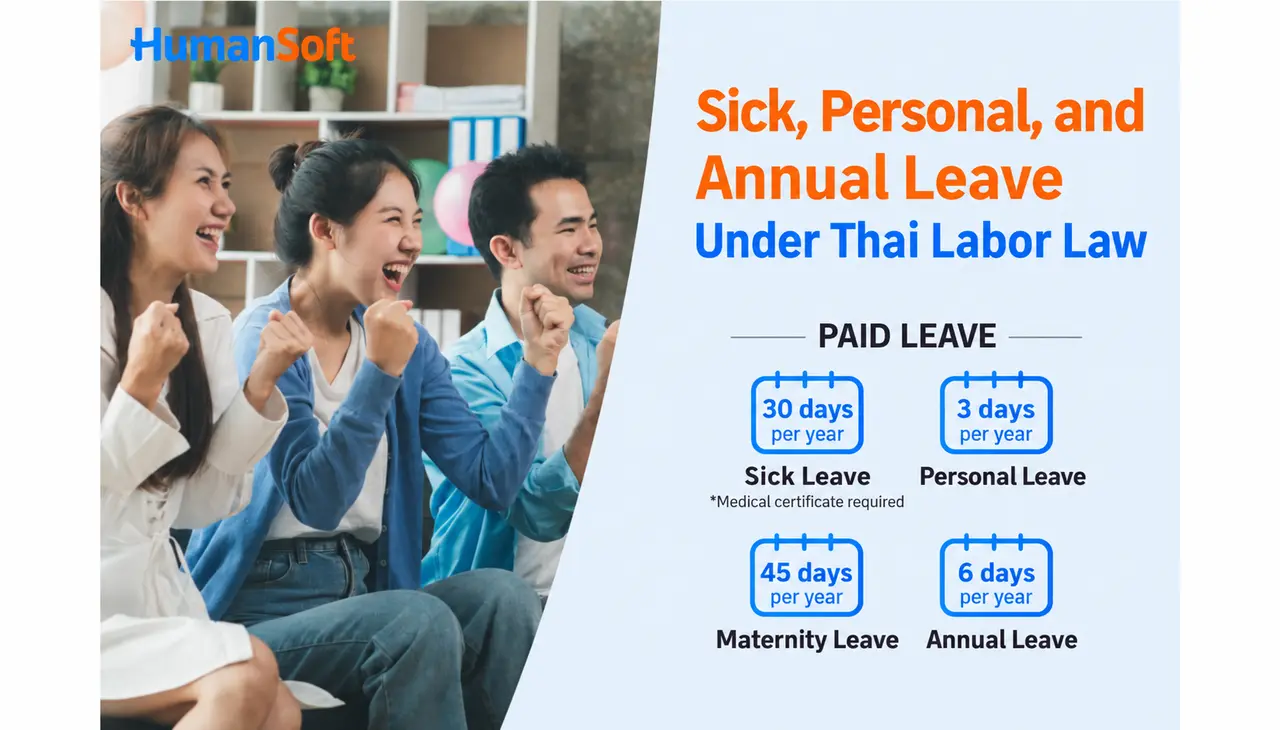
Under the Labour Protection Act B.E. 2541 (1998), employees are entitled to paid sick leave for up to 30 days per year, at least 3 paid working days of personal leave per year, and at least 6 paid annual leave days per year after completing one year of service. These are the statutory minimums, and employers may provide more generous benefits.
Annual leave, sick leave, and personal leave are all employee benefits. Each organization may set different leave conditions, making leave requests easier or more complicated depending on the workplace. However, did you know that leave entitlements are protected by law and every organization must comply? This article explains the legal requirements for each type of leave.
Table of Contents:
- How Many Days of Annual, Sick, and Personal Leave Are Allowed by Law?
- How Many Days Are Allowed for Each Type of Leave, and Are They Paid?
- How Many Days of Sick Leave Are Employees Entitled To?
- What Is Personal Leave, and How Many Days Are Allowed?
- How Many Days of Maternity Leave Are Employees Entitled To?
- How Many Days of Annual Leave Are Employees Entitled To?
- Summary: Are Wages Deducted for Personal, Sick, or Maternity Leave?
- FAQ: Frequently Asked Questions About Statutory Leave
How Many Days Are Allowed for Each Type of Leave, and Are They Paid?
| Type of Leave | Statutory Entitlement | Paid Leave Entitlement (Per Year) | Legal Reference (Labour Protection Act) |
| Sick Leave | As many days as the employee is actually ill | Paid for up to 30 days | Section 32 |
| Personal Leave | At least 3 working days per year | Paid for 3 days | Sections 34 and 56 (No. 7, B.E. 2562/2019) |
| Maternity Leave | Up to 120 days per pregnancy | Employer pays for 60 days (remaining benefits may be claimed from Social Security) |
Sections 41 and 59 (No. 9, B.E. 2568/2025) |
| Annual Leave | At least 6 working days per year (after completing one year of service) | Paid for 6 days | Sections 30 and 56 |
| Sterilization Leave | For the period prescribed by a physician | Regular wages are paid during the leave period | Sections 33 and 56 |
| Military Service Leave | For the actual period required by the authorities | Paid for up to 60 days | Sections 35 and 56 |
How Many Days of Sick Leave Are Employees Entitled To?
Let us begin with the first type of leave: “sick leave”. This leave applies when an employee becomes ill and needs time to recover. Sections 32 and 57 of the Labour Protection Act B.E. 2541 (1998) clearly state that
- employees may take sick leave for as long as they are actually ill.
- They are entitled to wages for up to 30 sick-leave days per year.
- If the employee exceeds this limit, the employer may deduct wages for the additional days in accordance with the organization’s rules.
What Is Personal Leave, and How Many Days Are Allowed?
If you need to take time off for urgent personal matters that cannot wait until a regular day off, this is called “personal leave”. This type of leave is relatively flexible and mainly depends on the organization’s policies. Examples of circumstances that may qualify for personal leave include:
- Taking a family member to a scheduled medical appointment
- Contacting a government agency, such as renewing an ID card or driver’s license, or appearing as a court witness
- Attending an important religious ceremony, a family funeral, an ordination ceremony, or traveling for Hajj
- Attending a graduation ceremony, whether your own or that of someone close to you
How Many Days of Personal Leave Are Employees Entitled To?
The Labour Protection Act provides that
- employers must allow employees at least 3 days of personal leave per year.
- These days must be paid.
For leave beyond the statutory entitlement, the company may deduct wages for those days. It may also consider the additional absence when determining attendance incentives or annual bonuses. If there is no reasonable cause, the company may also decline the leave request.
How Many Days of Maternity Leave Are Employees Entitled To?
Sections 41 and 59 of the current Labour Protection Act state that “a pregnant employee is entitled to maternity leave of up to 120 days” (information as of December 7, 2025). The employer must pay wages for up to 60 days, and the employee may also claim applicable benefits fromSocial Security.
How Many Days of Annual Leave Are Employees Entitled To?
Employees are entitled to at least 6 annual leave days per year. As always, the specific conditions depend on the organization. Some employers may provide 9, 10, or even 15 days. Below are a few useful points about annual leave that many employees commonly ask about.
Can Unused Annual Leave Be Carried Over to the Next Year?
This depends on company policy. The Labour Protection Act does not require employers to allow unused annual leave to be carried over, but employers and employees may agree on the arrangement.
Can Employees Who Have Worked for Less Than One Year Take Annual Leave?
Strictly under the law, “no”. Employees become entitled to statutory annual leave only after completing one year of service. However, an employer may choose to grant annual leave earlier to employees based on conduct, performance, or company policy.
Summary: Are Wages Deducted for Personal, Sick, or Maternity Leave?
Employers may not deduct wages when employees take leave within their statutory entitlements. Employees who believe their leave rights have been violated may file a complaint with the Department of Labour Protection and Welfare in their area during business days or submit a complaint online.
We hope this article helps employers and employees better understand the conditions for annual, personal, and sick leave. To make leave management more convenient, HumanSoft allows organizations toset leave quotasfor different leave types. The system reduces HR’s workload while keeping leave information accurate and easy for everyone to understand.
FAQ: Frequently Asked Questions About Statutory Leave
Q: Are probationary employees entitled to paid sick leave?
A: Yes. Probationary employees are entitled to paid sick leave.
Q: If sick leave falls next to a holiday, can the employer prohibit the leave or deduct wages?
A: No, provided that the employee is genuinely ill, because sick leave is a statutory right. However, if the employer suspects fraudulent sick leave, the employer may request a medical certificate for leave of 3 days or more or issue disciplinary action under company rules if fraud is established.
Q: Can an employee who has worked for less than one year use annual leave?
A: Not yet. Under labour law, employees become entitled to paid annual leave only after completing one year of service, with a minimum entitlement of 6 working days per year.
Q: Can a male employee take personal leave to care for his wife after childbirth?
A: Yes, and the leave is paid. The Labour Protection Act (No. 9), B.E. 2568 (2025), grants male employees who are spouses the right to take leave to assist their wife after childbirth for up to 15 days , with the employer paying wages based on the employee’s normal working days.
Read More Related Articles:
- Q&A: Can an Employer Dismiss an Employee for Taking More Than 30 Days of Sick Leave?
- Q&A: Can an Employer Deduct Wages When an Employee Exceeds Their Personal Leave Entitlement?
- Officially Announced: Thailand’s Latest Labour Law Grants 120 Days of Maternity Leave
- Q&A: How Many Consecutive Annual Leave Days Can Employees Take, and Can Leave Be Carried Over?


