
How to Write Interview Questions & What to Avoid
To write interview questions that genuinely assess candidates, first define the competencies the role requires, then choose questions from five groups: opening questions to get to know candidates, skills and experience questions, behavioral questions, situational questions, and questions about organizational fit and motivation. Use the same question set for every candidate applying for the same role, score answers against predefined criteria, and avoid personal questions, such as marital status, religion and health, that risk discrimination or conflict with personal data protection laws.
Table of Contents:
- How to Write Interview Questions & What to Avoid
- What Should HR Prepare Before an Interview?
- What Opening Questions Help You Get to Know Candidates?
- What Questions Assess Skills and Experience?
- How Should HR Ask Behavioral Interview Questions?
- When Should HR Use Situational Interview Questions?
- What Questions Assess Organizational Fit and Motivation?
- What Interview Questions Should HR Avoid?
- How Can HR Evaluate Candidates' Answers Fairly?
- What Should HR Do After the Interview?
- How Can HR Software Help Onboard New Employees?
- FAQ: Frequently Asked Questions About Interview Questions
What Should HR Prepare Before an Interview?
First, understand what the role requires, then choose questions that assess those requirements. Good preparation involves four steps.
- Review the Job Description: Summarize the main responsibilities and the outcomes the role must deliver.
- Define 3–5 competencies: Examples include job-specific skills, problem-solving, teamwork, and communication.
- Prepare a standardized question set: Choose questions that assess each competency and use the same set for every candidate (Structured Interview).
- Create a scorecard: Define the criteria for scores of 1–5 for each question before interviewing begins.
What Opening Questions Help You Get to Know Candidates?
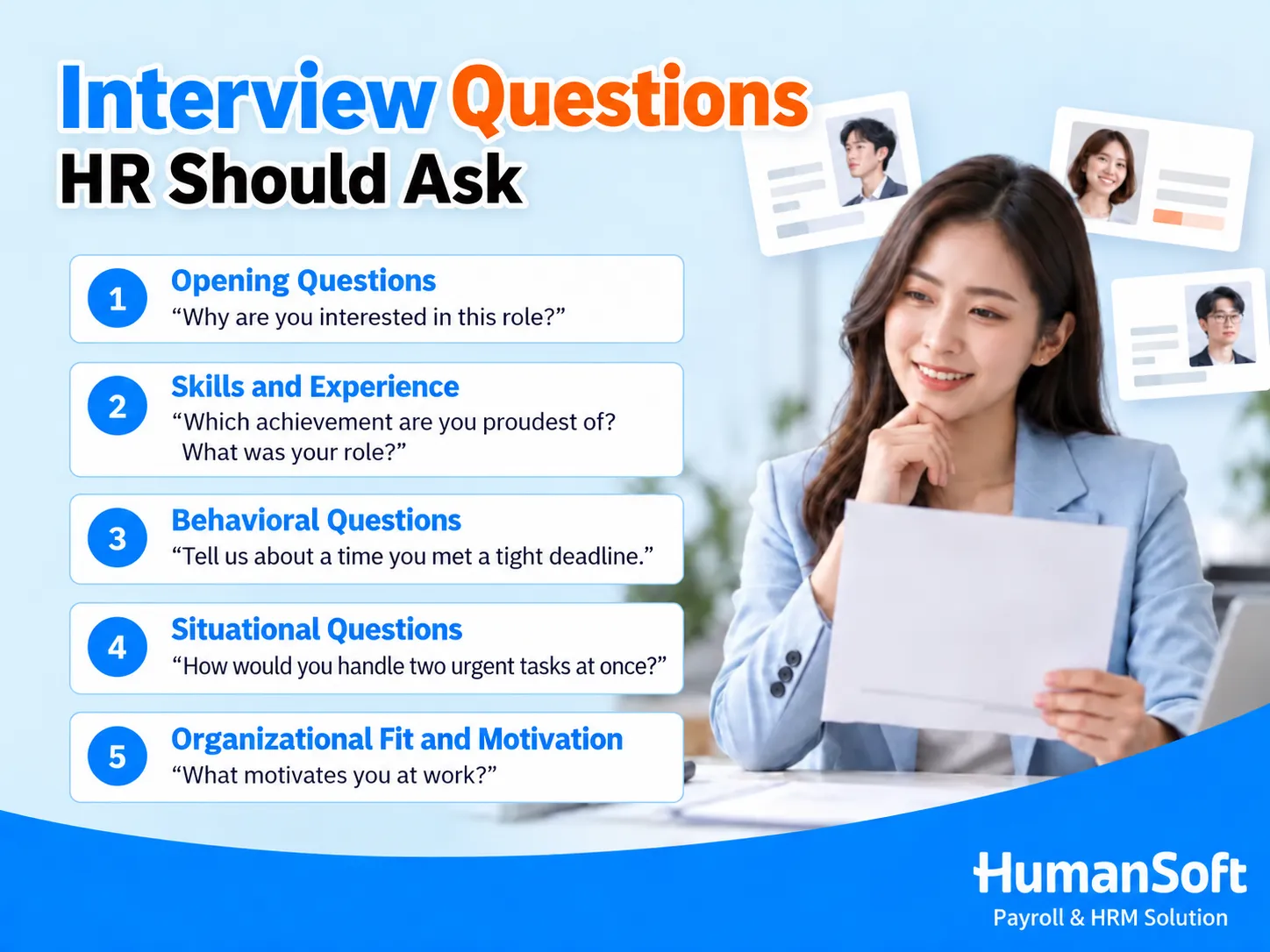
These questions help candidates relax and give HR an overview of their background, goals, and communication style. For the most common questions and why HR asks each one, see 10 Interview Questions and What to Listen For.
- Tell us about yourself and your career so far.
What to listen for: A logical structure and the ability to select information relevant to the role. - Why are you interested in this position?
What to listen for: Understanding of the role and reasons for applying. - How did you hear about our company, and what do you know about us?
What to listen for: Preparation before the interview. - Why are you looking to change jobs now?
What to listen for: Reasonable explanations without excessive criticism of a previous employer. - What strengths make you a good fit for this role?
What to listen for: Relevant strengths supported by examples. - Where would you like to see yourself in three years?
What to listen for: Goals that align with career opportunities in the organization.
What Questions Assess Skills and Experience?
Use these questions to check whether candidates can perform the role. Adapt them to the tools and tasks involved in each position.
- What were your main responsibilities in your previous role, and how was your performance measured?
What to listen for: Actual responsibilities and clear performance indicators. - What achievement are you most proud of, and what was your contribution?
What to listen for: The candidate's individual role compared with the team's contribution, and measurable results. - What tools or software do you use at work, and how proficient are you?
What to listen for: A level of proficiency that matches the role. - What would you prioritize in your first month in this role?
What to listen for: Understanding of the work and the ability to prioritize. - What skills are you currently developing?
What to listen for: Independent learning and awareness of development needs. - Please explain how you carry out [a key task for the role].
What to listen for: In-depth knowledge and the ability to explain it clearly to others.
How Should HR Ask Behavioral Interview Questions?
Behavioral questions ask candidates to describe real experiences, because past behavior helps predict future performance. Listen for answers that follow the STAR structure.
- S – Situation: The context of the event, including where and when it happened.
- T – Task: What the candidate was responsible for in that situation.
- A – Action: What the candidate personally did, rather than what the team did.
- R – Result: The outcome and lessons learned.
Examples of Behavioral Interview Questions
- Tell us about a time you had to complete a task under a very tight deadline.
Assesses: Time management and handling pressure. - Tell us about a time you disagreed with a manager or colleague. How did you handle it?
Assesses: Communication and conflict management. - Describe a mistake you made at work and how you corrected it.
Assesses: Accountability and learning. - Tell us about a time you suggested a new way of working that improved results.
Assesses: Initiative. - Tell us about a time you worked with someone who was difficult to work with.
Assesses: Teamwork. - Tell us about a time you had to learn something new quickly.
Assesses: Learning and adaptability.
When Should HR Use Situational Interview Questions?
Situational questions take the form "What would you do if…?" They are useful for candidates with limited experience, such as recent graduates, because they assess how candidates think even if they have not faced the situation before.
- What would you do if two different managers assigned you urgent tasks at the same time?
What to listen for: Prioritization and communication with managers. - How would you handle an unhappy customer who speaks rudely to you?
What to listen for: Emotional control and solving the customer's problem. - What would you do if a teammate repeatedly made mistakes?
What to listen for: Constructive feedback. - How would you start a task if you lacked the knowledge needed to complete it?
What to listen for: Research and asking for help. - What would you do if a project's goals suddenly changed close to the deadline?
What to listen for: Flexibility and replanning. - What would you do if you discovered information suggesting a possible breach of company rules?
What to listen for: Workplace ethics.
What Questions Assess Organizational Fit and Motivation?
These questions help assess whether a candidate's values, working style, and expectations align with the team and organization.
- What kind of work environment helps you perform at your best?
What to listen for: A working style that fits the team. - What type of manager do you work best with?
What to listen for: Expectations of a manager's leadership style. - What motivates you at work?
What to listen for: Motivations the organization can support. - What do you expect from this new role?
What to listen for: Expectations that match what the position can realistically offer. - What salary range are you expecting?
What to listen for: A salary range within the role's budget. - Do you have any questions for us?
What to listen for: Genuine interest in the role and organization.
What Interview Questions Should HR Avoid?
Avoid personal questions unrelated to job performance, as they risk discrimination under the Gender Equality Act B.E. 2558 (2015). They may also involve collecting sensitive data, such as religion, health information, and criminal records, for which the Personal Data Protection Act B.E. 2562 (2019) (PDPA) requires a legal basis or prior consent.
| Topic | Questions to avoid | What to ask instead |
|---|---|---|
| Marital status and family | Are you married? Do you plan to have children? | This role requires travel outside the province twice a month. Are you available to do that? |
| Age | How old are you? | (Ask only when the role has a statutory age requirement.) |
| Religion | What religion do you practice? | Are you available to work the required shift schedule, including Saturdays? |
| Gender and sexual orientation | Is your partner a woman or a man? | (Unrelated to the job; do not ask.) |
| Health | What chronic health conditions do you have? | This role requires lifting items weighing approximately 20 kg. Can you do that? |
| Criminal history | Have you ever been in prison? | (Check criminal records only for roles where necessary, and obtain consent first.) |
How Can HR Evaluate Candidates' Answers Fairly?
Score every candidate using the same scorecard immediately after the interview. Assess each competency separately, and have each panel member score independently before comparing results to reduce first-impression bias. See more examples in Interview Scoring Criteria.
| Score | Rating | Description |
|---|---|---|
| 5 | Excellent | Covers every STAR element, with clear examples and measurable results. |
| 4 | Good | Answers the question with examples, but the results are not yet clear. |
| 3 | Satisfactory | Answers the question, but examples are general and lack detail. |
| 2 | Below expectations | Does not answer the question directly or cannot provide an example. |
| 1 | Does not meet requirements | Has no relevant experience, or the answer conflicts with the role's requirements. |
What Should HR Do After the Interview?
Communicate the outcome promptly and prepare new employee information before the start date.
- Summarize scores and select a candidate: Compare scorecards from all panel members.
- Check references: Proceed with the candidate's consent.
- Notify every candidate: Inform both successful and unsuccessful candidates to maintain a positive employer image.
- Make an offer and prepare an employment contract: Clearly specify the position, salary, benefits, and start date.
- Prepare for the first day: Record employee information, set up payroll and working hours, and register the employee for social security within 30 days
When hiring foreign employees, complete the Work Permit process before their start date.
How Can HR Software Help Onboard New Employees?
When employee information, working hours, and payroll are managed in one system, HR does not need to re-enter information when onboarding new hires. Once a candidate is hired, HR can immediately set up online time and attendance tracking and payroll software for the new employee.
Learn more about HumanSoft pricing or start a free 30-day trial.
FAQ: Frequently Asked Questions About Interview Questions
Q: How do you write interview questions that genuinely assess candidates?
A: Start by defining 3–5 competencies the role requires, then choose questions that assess each one. Use behavioral questions so candidates describe real experiences, ask every candidate the same set, and set scoring criteria before the interview begins.
Q: What is a Structured Interview?
A: It is an interview that uses the same question set and scoring criteria for every candidate applying for the same role, allowing fairer comparisons than choosing questions by intuition.
Q: What is the STAR Method?
A: It is a structure for answering behavioral questions: Situation, Task, Action, and Result. HR uses it to check whether candidates give a complete account of a real experience.
Q: Should HR ask candidates about marriage or plans to have children?
A: No. These questions are unrelated to job performance and risk discrimination. If the role has specific requirements, such as frequent travel, ask whether the candidate can meet those requirements instead.
Q: Can HR ask about salary expectations during an interview?
A: Yes. Ask for a salary range to see whether expectations fit the role's budget, and share the position's salary range and benefits with the candidate as well.
Q: How long should a job interview last?
A: An interview generally takes 30–60 minutes per candidate, covering introductions, competency-based questions, and time for the candidate's own questions. Senior positions may require more than one interview round.
Read More Related Articles
- 10 Interview Questions and What to Listen For
- Interview Scoring Criteria with a Sample Form
- How Employers Can Register Employees for Social Security Online
- Thai Work Permit: What It Is, How to Apply and When to Renew
- Thai Social Security Contributions 2026: How Much Is Deducted and How Employers Pay
