
10 Interview Questions and What to Listen For
The 10 interview questions HR asks most often cover the candidate's introduction, why they fit the job, why they are interested in the position, how their experience can help, why they left their previous job, their strengths, their weaknesses, how they handle pressure, their expected salary, and their future goals. Each question below explains why HR asks it and what to listen for in the answer. For behavioral and situational questions, and questions HR should avoid, read How to Write Interview Questions & What to Avoid.
What Are the 10 Most Common Interview Questions?
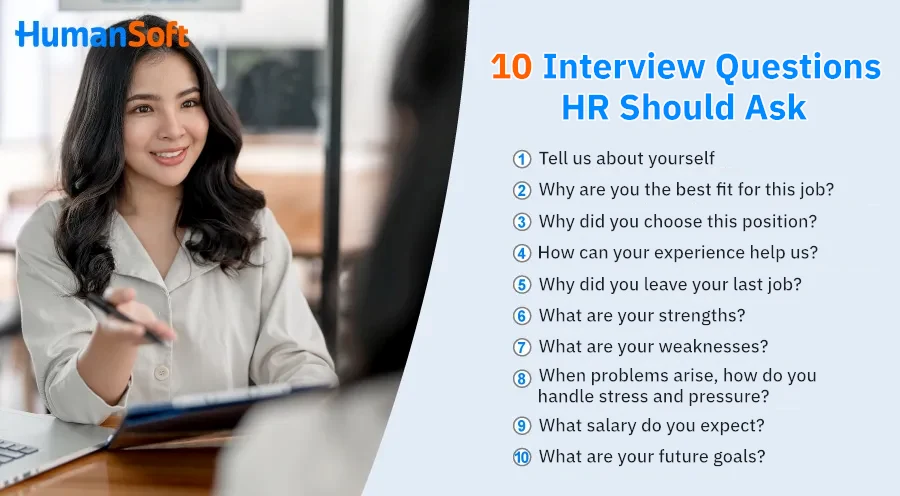
1. Tell us a little about yourself
This is one of the most popular questions and usually one of the first HR asks. It helps HR get to know the candidate as a whole, including their attitude, personality and the small details that show how well they suit the position.
What to listen for: A logical flow and a focus on stories relevant to the job.
2. Why do you think you are the best fit for this job?
This question shows HR the candidate's confidence and ability, and how well they suit the role. It is the moment when candidates need to sell themselves to HR.
What to listen for: Strengths that match the job, supported by examples.
3. Why did you choose this position?
This question shows how well the candidate understands the duties of the position and whether they researched the company, its organizational structure and its culture before the interview.
What to listen for: Understanding of the role and the company, and the reasons for applying.
4. How can your experience help us?
Beyond revealing the candidate's past experience, this question helps HR judge whether the candidate can deliver the work the company assigns as intended.
What to listen for: Past achievements that match the duties of this role.
5. Why did you leave your previous job?
Another favorite HR question. It reveals why the candidate left their previous job and helps HR understand their work values.
What to listen for: A reasonable explanation without being overly negative about the previous employer.
6. What are your strengths?
This question can really separate candidates. It shows their outstanding qualities and abilities, and how well they fit the position.
What to listen for: Strengths that genuinely apply to this job, backed by real situations.
7. What are your weaknesses?
After learning about strengths, HR also needs to understand the candidate's weaknesses, whether they are ready for the role, and how they would turn a weakness into a strength when facing challenges.
What to listen for: Self-awareness and a development plan they are actually following.
8. When problems arise, how do you handle stress and pressure?
Every role involves some stress and pressure. This question shows whether the candidate can cope with pressure and manage stress.
What to listen for: A real situation they have faced, described fully using the STAR structure.
9. What salary do you expect?
This question tests the waters. Many candidates feel unsure how to answer it, but it tells HR how much the candidate expects to earn, how flexible they are and the reasons behind the figure, which helps HR judge whether they fit the role.
What to listen for: A salary range within the role's budget, and how flexible it is.
10. What are your future goals?
This question tells HR how long the candidate wants to stay with the organization, whether they would leave for a better offer, or whether the role is only a temporary stop. It gives HR better information for the hiring decision.
What to listen for: Goals that align with career paths in the organization.
Summary: The 10 Questions and What to Listen For
These 10 questions work for almost any role. Use the same set with every candidate for the same position, and score answers right after the interview. See example criteria and a form in Interview Scoring Criteria.
| Question | What to listen for in the answer |
|---|---|
| 1. Tell us a little about yourself | A logical flow and a focus on stories relevant to the job |
| 2. Why do you think you are the best fit for this job? | Strengths that match the job, supported by examples |
| 3. Why did you choose this position? | Understanding of the role and the company, and the reasons for applying |
| 4. How can your experience help us? | Past achievements that match the duties of this role |
| 5. Why did you leave your previous job? | A reasonable explanation without being overly negative about the previous employer |
| 6. What are your strengths? | Strengths that genuinely apply to this job, backed by real situations |
| 7. What are your weaknesses? | Self-awareness and a development plan they are actually following |
| 8. When problems arise, how do you handle stress and pressure? | A real situation they have faced, described fully using the STAR structure |
| 9. What salary do you expect? | A salary range within the role's budget, and how flexible it is |
| 10. What are your future goals? | Goals that align with career paths in the organization |
FAQ: Using These 10 Questions
Q: What are psychological interview questions?
A: Questions often called psychological questions look at how candidates think and cope, such as "When problems arise, how do you handle stress and pressure?" or "What are your weaknesses?" Ask candidates to give real examples rather than using trick questions with no right or wrong answer.
Q: What do candidates usually ask HR at the end of an interview?
A: Candidates often ask about responsibilities in the first three months, how performance is measured, the team they would work with, and the next steps after the interview. HR should prepare answers in advance. If a candidate asks nothing at all, they may not have researched the role enough.
Q: Can these 10 questions be used with recent graduates?
A: Yes, almost all of them. For questions 4 and 5, which ask about previous jobs, ask about internships, activities or university projects instead, and add situational questions such as "What would you do if…?" to see how candidates without work experience think.
Read More Related Articles


