

When Is a Medical Certificate Required for Sick Leave Under Labor Law?
A common challenge for HR and supervisors is the question: “How many days of sick leave require a medical certificate?” The answer is: “If an employee takes sick leave for 3 working days or more, the employer may request a medical certificate.”
The Labour Protection Act provides that “employees are entitled to sick leave for as long as they are actually ill and to paid sick leave for up to 30 working days per year.” While the law protects employees, employers may not always be able to determine whether each sick leave request is genuine or whether it involves false sick leave. For this reason, a medical certificate can serve as important supporting documentation and help ensure fairness for employers.
Table of Contents:
- When Is a Medical Certificate Required for Sick Leave Under Labor Law?
- How Many Sick Leave Days Are Taken, and What Can the Employer Do?
- Medical Certificates for Sick Leave: A Simple Summary for HR
- Summary: When Is a Medical Certificate Required for Sick Leave Under Labor Law?
- FAQ: Frequently Asked Questions About Employee Sick Leave Rights and Medical Certificates
How Many Sick Leave Days Are Taken, and What Can the Employer Do?
| Case | Is a Medical Certificate Required? | What the Employer Can Do |
|---|---|---|
| 1–2 Working Days of Sick Leave | Not mandatory | The employer may ask the employee to explain the absence or provide other evidence in accordance with work regulations, but cannot reject the sick leave or deduct pay solely because there is no medical certificate. |
| 3 Working Days or More of Sick Leave | The employer may request one from a first-class modern medical practitioner or a government medical facility. | The employer may request the medical certificate and, if the company provides a physician, may require the employee to be examined by that physician. |
| 3 or More Working Days of Sick Leave Without a Medical Certificate | The employee must explain the reason. | If the explanation is reasonable, the absence is treated as valid sick leave. If the employee does not explain or the explanation is not acceptable, the employer may withhold pay for that day and issue a warning under the work regulations. If the employee is absent for 3 consecutive working days without reasonable cause, the employer may terminate employment without severance pay under Section 119(5). |
See the steps HR should take when an employee takes 3 or more days of sick leave without a medical certificate >> 3 Consecutive Days of Sick Leave Without a Medical Certificate: What Can an Employer Do?
Medical Certificates for Sick Leave: A Simple Summary for HR
To manage employees correctly under the Labour Protection Act while maintaining a positive team environment, here is a clear summary of what HR and employees should know about medical certificates for sick leave.
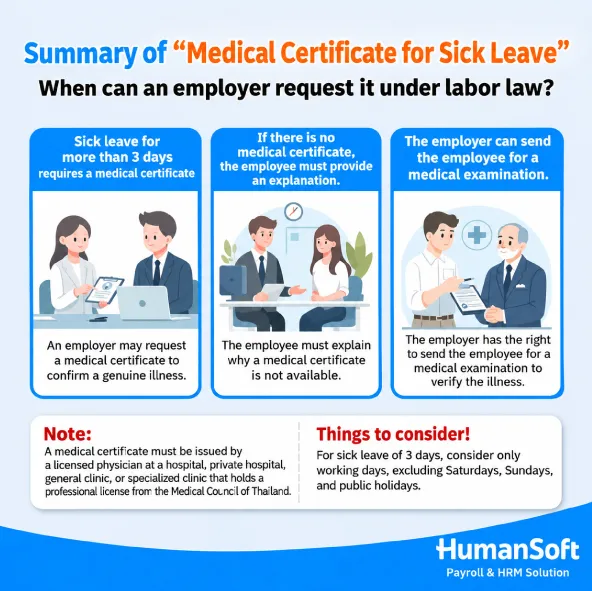
1. For Sick Leave of 3 Working Days or More, a Medical Certificate May Be Requested
For sick leave of 3 working days or more, an employer may request a certificate from a first-class modern medical practitioner to verify that the employee is genuinely ill.
2. If There Is No Medical Certificate, the Employee Must Explain the Reason
If an employee takes sick leave for 3 working days or more but cannot obtain a certificate from a first-class modern medical practitioner, the employee must explain the reason to the employer.
3. The Employer May Send the Employee to a Company-Provided Physician
If the company has an in-house physician or the employer provides a physician, the employer may require the employee to be examined by that physician to verify the illness.
Important: When counting 3 days of sick leave, count only “working days.” Saturdays, Sundays, or other holidays that fall in between are not included.
Note: A “first-class modern medical practitioner” means a physician working at a public or private hospital or a general medical clinic who holds a medical practice license issued by the Medical Council of Thailand.
Summary: When Is a Medical Certificate Required for Sick Leave Under Labor Law?
Under the Labour Protection Act, employees are entitled to sick leave for as long as they are actually ill and to paid sick leave for up to 30 working days per year. An employer may request a medical certificate when sick leave lasts 3 working days or more. For only 1–2 days of sick leave, the employer cannot require a medical certificate but may ask the employee to explain the reason.
FAQ: Frequently Asked Questions About Employee Sick Leave Rights and Medical Certificates
Q: Can an Employer Require a Medical Certificate for 1–2 Days of Sick Leave?
A: The employer cannot require one, but the company may establishwork regulationsrequiring employees to provide a verbal explanation or other evidence of medical treatment. If an employee is genuinely ill but has no medical certificate, the employer cannot reject the sick leave or deduct pay solely for that reason.
Q: What Should an Employee Do If They Have No Medical Certificate for Sick Leave of 3 Days or More?
A: The law allows an employee who cannot provide a medical certificate to explain the circumstances to the employer, such as becoming suddenly ill and being unable to travel to a hospital, or treating the illness with over-the-counter medicine. HR should consider each case appropriately based on its circumstances.
Q: Can an Employee Be Terminated for Forging a Medical Certificate?
A: If an employee is found to haveforged a medical certificate this may be considered serious dishonesty against the employer. The employer may terminate the employee immediately without payingseverance pay under Section 119(1) of the Labour Protection Act.
Read More Related Articles
- Q&A: Can an Employer Issue a Warning for Leave Without a Medical Certificate?
- Summary of Leave Rights Under Labor Law: How Many Days for Each Type?
- Frequent Sick Leave and Suspected False Sick Leave: Guidelines for HR
- Q&A: Can an Employer Terminate an Employee Who Takes More Than 30 Days of Sick Leave?
- Q&A: Can Employers Ban Sick Leave Frequently Taken Next to Holidays?
