
Comprehensive Payroll Outsourcing: Payroll, Tax, and Social Security
Payroll outsourcing (Payroll Outsourcing) means hiring an external service provider to manage payroll on behalf of the HR team—from reviewing attendance records and calculating salaries and OT to deducting taxes and Social Security contributions, preparing P.N.D.1 S.P.S.1-10 forms, and producing supporting reports for each payroll cycle. The organization still makes decisions and approves every payroll cycle, but no longer has to handle all calculations and paperwork internally.
What Does Payroll Outsourcing Cover?
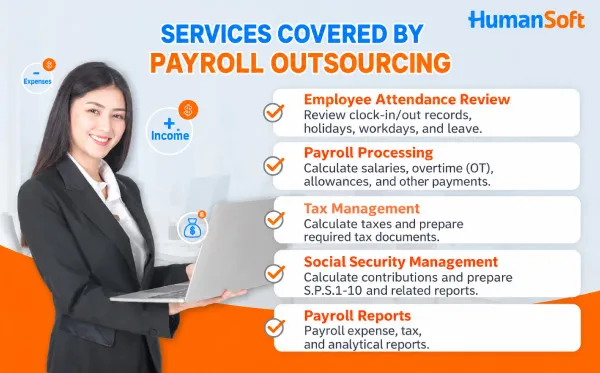
1. Review Employee Attendance Records
Review and collect employee attendance data, including clock-in and clock-out records, holidays, workdays, and leave. This information is essential for accurate payroll calculations
2. Payroll Processing
This service helps organizations manage employee payroll accurately and on time, from salary calculations and overtime (OT) to allowances and other payments, while reducing the risk of errors.
3. Tax Management
This covers tax calculations and document preparation, including monthly income tax reports (P.N.D.1), annual income tax reports (P.N.D.1 Kor), and employee withholding tax certificates (50 Tawi). These documents require specialized knowledge, and payroll outsourcing helps ensure that your organization complies with legal requirements.
4. Social Security Management
Payroll outsourcing also covers Social Security calculations, the preparation of Social Security contribution reports (S.P.S.1-10), and related reports. These tasks are handled comprehensively and systematically, reducing complex administrative work for HR.
5. Payroll Reports
The service includes reports such as payroll expense reports, tax reports, and other insights that help organizations analyze data and plan finances and organizational development more effectively.
Table of Contents:
- Comprehensive Payroll Outsourcing: Payroll, Tax, and Social Security
- What Does Payroll Outsourcing Cover?
- In-House Payroll vs. Payroll Outsourcing: What Is the Difference?
- Summary: Comprehensive Payroll, Attendance, Tax, and Social Security Services
- FAQ: Frequently Asked Questions About Payroll Outsourcing
In-House Payroll vs. Payroll Outsourcing: What Is the Difference?
|
Category |
In-House Payroll |
Payroll Outsourcing |
|
Personnel |
Requires an internal team member with payroll, tax, and Social Security expertise |
Handled by the service provider's team |
|
System Costs |
Purchase and maintain the software internally |
Included in the service fee |
|
Keeping Up with Legal Changes |
Monitor changes and update conditions internally |
The service provider monitors changes |
|
Flexibility for Urgent Corrections |
Corrections can be made immediately in-house |
Requests must follow the agreed service schedule |
|
Continuity When Staff Resign |
Work may be disrupted if the responsible employee resigns |
Work continues because it is handled by the provider's team |
*Information as of September 2026
Read the detailed comparison >> In-House Payroll or Payroll Outsourcing: Which Is Better?
Summary: Comprehensive Payroll, Attendance, Tax, and Social Security Services
Payroll outsourcing covers everything from collecting attendance data and calculating salaries and OT managing taxes and Social Security, and generating supporting reports for each payroll cycle. The organization gains more than just the HR team's time; HR it transfers error-sensitive work that may lead to penalties to professionals who handle it every day. Before deciding, clearly agree on whether the provider will only prepare documents or also submit them on your behalf.
Learn more about the service at HumanSoft Payroll Outsourcing Service
FAQ: Frequently Asked Questions About Payroll Outsourcing
Q: How are payroll outsourcing fees calculated?
A: Most providers charge per employee per payroll cycle and usually apply a minimum monthly service fee for small organizations.
Q: Will the service provider submit P.N.D.1 and S.P.S.1-10 on our behalf?
A: Most providers prepare the documents for submission, but the organization usually submits them itself.
Q: How secure is employee payroll data, and who can access it?
A: Payroll information is personal data protected under the PDPA . Organizations should establish a data processing agreement with the provider specifying who can access the data, how long it will be retained, and what must happen when the contract ends.
Q: Can we start using the service mid-year, or must we wait until the beginning of a new year?
A: You can start mid-year, but you must provide each employee's year-to-date income and tax withheld. This ensures that subsequent tax calculations and year-end withholding tax certificates include complete annual totals.
Q: Is payroll outsourcing worthwhile for a small company with 10 employees?
A: Value depends more on complexity than headcount. A small organization with a straightforward pay structure may manage payroll software internally. However, if it has multiple pay rates, several types of OT , or no one with tax and Social Security expertise, outsourcing is often more cost-effective than risking incorrect filings.
More Articles You May Be Interested In:
- What to Prepare When Choosing Payroll Outsourcing with HumanSoft
- In-House Payroll or Payroll Outsourcing: Which Is Better?
- Payroll Outsourcing What Is It? Is It Worthwhile? Why Do Businesses Need It?
- Payroll Outsourcing: A Cost-Effective Solution for Businesses in the Digital Age
- What Is Payroll Outsourcing? Answers for Businesses Exploring the Service


