


What Is Base Salary and Why Is It Important for Payroll Calculations?
Base salary is the regular compensation an employer agrees to pay an employee based on their position and responsibilities. It generally excludes overtime, bonuses, and other special income. Base salary is used as a reference for calculating compensation, taxes, social security contributions, and labor benefits. However, statutory benefit calculations must also consider other payments that qualify as wages, rather than relying on base salary alone.
Table of Contents:
- What Is Base Salary and Why Is It Important for Payroll Calculations?
- What Is Base Salary?
- The Role of Base Salary in Payroll
- Base SalaryWhy Is It Important for Payroll Calculations?
- Summary: What Is Base Salary and Why Is It Important for Payroll Calculations?
- FAQ: Frequently Asked Questions About Base Salary
What Is Base Salary?
Base salary is the basic monthly compensation an employer sets for an employee based on their position and responsibilities. It does not include other income such as overtime pay bonuses orbenefits. Base salary serves as an important starting point for calculating compensation, benefits, taxes, andsocial security contributions
In addition, base salary reflects fairness within the organization, supports workforce cost management, and promotes transparency in compensation management. It is also important in terms oflabor law , such as minimum wage requirements and the calculation ofseverance payupon termination, as well associal security benefitsthat employees are entitled to receive.
The Role of Base Salary in Payroll
Base salary is not only the employee’s basic compensation. It also plays an important role in calculating related benefits, including wages, overtime pay, employee benefits, taxes, and social security contributions, as well as in organizational budget planning. Here is how each role affects HR management.
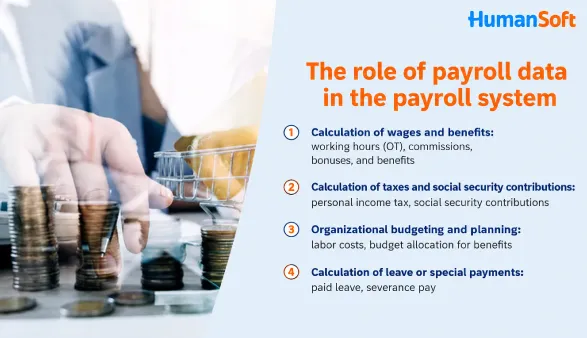
1. Calculating Wages and Benefits
Base salary is an important factor in calculating employee compensation and benefits, such as:
- Overtime Pay (OT): Calculated from the applicable wage rate based on normal working hours and multiplied by the legally prescribed overtime rate (1.5x, 2x, or 3x).
- Commission: In some organizations, base salary may also be used as a reference when calculatingcommission
- Bonuses and Benefits: Performance- or tenure-based bonuses may use base salary as a reference for determining payment levels, such as a bonus equal to two months of base salary.
2. Calculating Taxes and Social Security Contributions
- Personal Income Tax: Base salary is an important input forwithholding tax calculations , taking into account progressive tax rates andtax allowances and deductions
- Social Security: Social security contributions are calculated from the applicable wage base at the rate prescribed by law. The rate stated in this source is 5%, subject to the applicable contribution ceiling.
3. Organizational Budget Planning
Base salary helps organizations plan workforce budgets effectively, for example:
- Forecasting employee hiring costs
- Estimating total costs from additional hiring or salary increases
- Allocating budgets for benefits such as health insurance and provident funds
4. Calculating Leave Pay and Special Compensation
- Pay During Leave: For example, sick leave, maternity leave, or annual leave may be calculated by dividing base salary by the number of normal working days in that month.
- Severance Pay: When an employee is terminated, base salary may be used as part of the severance calculation based on length of service, such as 3 months of pay for an employee who has worked for more than 1 year but not more than 3 years.
Base SalaryWhy Is It Important for Payroll Calculations?
Base salary is an important component directly linked to labor law, from minimum wage requirements to benefit calculations, as follows:
1. Minimum Wage Requirements
Labor law requires employee pay to meet the minimum wage applicable in the work location. For example, if the local minimum wage is THB 350 per day, a monthly equivalent calculated at 30 days would be THB 10,500 (THB 350 × 30 days).
2. Calculating Severance Pay Upon Termination
When an employee is terminated, the employer may be required to pay severance according to the rates prescribed by labor law, based on wages and length of service. For example:
- 1–3 years of service: 90 days of severance pay (3 months)
- More than 10 years of service: 300 days of severance pay (10 months)
3. Calculating Overtime and Holiday Pay
The law requires employers to pay overtime at specified rates calculated from the applicable hourly wage, for example:
- Overtime on a normal workday: 1.5 times the hourly wage
- Overtime on a holiday: 3 times the hourly wage
4. Social Security Contributions and Benefits
- Contributions: Employers and employees must make social security contributions at the prescribed rate based on the applicable contribution wage base. For example, if the wage base is THB 15,000, a 5% contribution would equal THB 750.
- Benefits: Employees may be entitled to social security benefits such as medical benefits, maternity benefits, unemployment compensation, or pensions.
Summary: What Is Base Salary and Why Is It Important for Payroll Calculations?
Base salary is an important part of payroll management and labor-law compliance. Managing base salary appropriately not only improves HR efficiency but also helps ensure that employee rights are handled correctly under the law.
Payroll Outsourcing Servicesfrom HumanSoft can support end-to-end payroll management related to base salary, from wage and overtime calculations to benefits, taxes, and social security. This helps reduce complexity, save time and manpower, and improve operating cost efficiency.
FAQ: Frequently Asked Questions About Base Salary
Q: What is the difference between base salary and total income?
A: Base salary is the basic compensation agreed in the employment contract for the employee’s position and responsibilities, before other additional payments. Total income is base salary plus all other income the employee receives in that month.
Q: Are position allowances or professional allowances included when calculating OT and social security?
A: Under labor law, if a position allowance or professional allowance is paid as a fixed amount every month without performance conditions, it may be treated as “wages.” In that case, it should be included with base salary when determining the base for overtime pay (OT), severance pay, and social security contributions.
Q: Can a company reduce an employee’s base salary due to economic conditions?
A: Not immediately. Because base salary is part of the employee’s terms of employment, reducing it generally requires the employee’s written consent. If the employee does not agree, a unilateral reduction may breach the employment agreement and conflict with labor law.
Read More Related Articles
- Q&A Employee Base Salary Adjustment: What Should HR Consider?
- How Should Employers Handle Employee Salary Increase Requests?
- Plan Salary Adjustments More Easily with HR Software
- What Is Payroll? A Guide to Managing Salary Payments
- Complete Payroll Outsourcing Services: Convenient, Accurate, and Suitable for Every Organization


