
What Is Overtime Pay (OT)?
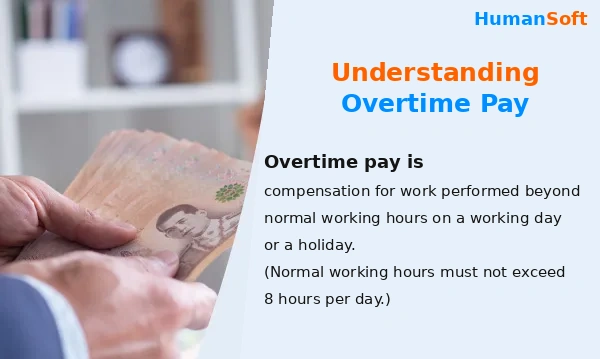
Overtime pay, or OT, is compensation an employer must pay when an employee works beyond 8 hours per day. Thai labour law requires overtime on a normal working day to be paid at no less than 1.5 times the hourly wage, while overtime on a holiday must be paid at no less than 3 times the hourly wage. This article explains overtime rates in different situations and the legal limits on overtime hours.
How Much Overtime Pay (OT) ) Is Paid in Each Case?
When an employer asks an employee to work overtime, the amount payable and the employee’s entitlements depend on the type of workday and employment arrangement, as follows.
Wages
Must be paid at no less than the minimum wage and covers normal working hours only.
Overtime on aNormal Working Day OT What Is the Rate?
The employer must pay overtime at no less than 1.5 times the employee’s hourly wage on a normal working day, based on the number of overtime hours worked.
Overtime on aHoliday OT What Is the Rate?
The employer must pay holiday overtime at no less than 3 times the employee’s hourly wage on a normal working day, based on the number of overtime hours worked.
Daily Wage Employees vs Monthly Salaried Employees How Does Holiday Pay Differ?
Employees can be divided into two categories as follows:
- Daily Wage Employees Daily wage or piece-rate employees are not paid for a holiday if they do not work. If they work on the holiday, they must receive holiday work pay of no less than 2 times their normal wage.
- Monthly Salaried Employees Monthly employees receive a fixed monthly salary regardless of the number of working days or holidays in the month. They are therefore entitled to their regular wages even when they do not work on a holiday.
How Many Overtime Hours (OT) ) Per Week Are Legally Permitted?
The Department of Labour Protection and Welfare states that requiring employees to work overtime and on holidays for more than 36 hours per week is unlawful.Labour Law An employer who fails to comply may face imprisonment for up to 6 months, a fine of up to THB 100,000, or both.
| Type of Work | Maximum OT Hours per Week | Notes |
| General Work | No more than 36 hours | Under Section 24 of the Labour Protection Act |
| Hazardous Work | No more than 36 hours | Employee consent is required |
Summary: How to Arrange Overtime Without Violating the Law
An employer must obtain the employee’s consent before requiring overtime and must not force an employee to work overtime. Employers must provide fair wages, overtime pay, holiday pay, and all other statutory entitlements. Combined overtime and holiday work must not exceed 36 hours per week. Violations of the Labour Protection Act may result in imprisonment for up to 6 months, a fine of up to THB 100,000, or both.
FAQ: Frequently Asked Questions About Overtime
Q: What is the overtime rate on a normal working day?
Q: What is the overtime rate on a holiday?
Q: Can an employer force an employee to work overtime?
Q: Can monthly salaried employees receive overtime pay?
Q: Is exceeding the weekly overtime limit illegal?
Read More Related Articles