
Can HR Refuse an Employee’s Personal Leave Request Under Labor Law?
Employees are entitled to at least 3 working days of leave for necessary personal business. Employers must pay wages for personal leave at the normal working-day rate, for up to 3 working days per year.
If an employee takes personal leave for necessary business, follows company rules, and clearly explains the reason, the employer or HR cannot simply refuse the leave. However, if the employee fails to follow company rules properly, the absence may be treated as abandonment of duty.
Table of Contents:
- Can HR Refuse an Employee’s Personal Leave Request Under Labor Law?
- Personal Leave Rights Under Labor Law
- What Criteria Should Employers Use When Considering Personal Leave?
- Examples of Necessary Personal Business Leave
- Summary: Can HR Refuse Personal Leave Under Labor Law?
- FAQ: Frequently Asked Questions About Personal Leave Under Labor Law
Personal Leave Rights Under Labor Law
Under Section 34 of the Labour Protection Act, employees are entitled to at least 3 days of leave per year for necessary personal business. Employees are entitled to wages at the normal working-day rate during such leave, for up to 3 days per year under Section 57/1. A company may provide more than 3 days of personal leave per year, but it should not provide less than the statutory minimum of 3 days.
What Criteria Should Employers Use When Considering Personal Leave?
Personal leave rights under Section 34 of the Labour Protection Act , employees are entitled to at least 3 working days of leave per year for necessary personal business. Employees are entitled to wages at the normal working-day rate during such leave, for up to 3 working days per year under Section 57/1. A company may provide more than 3 days of personal leave per year, but not less than 3 days.
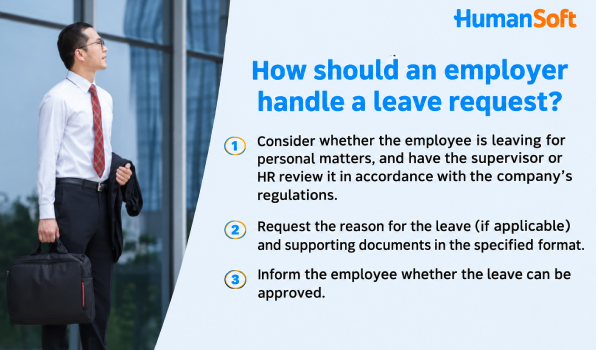
- Check whether the employee submitted the personal leave request in advance so the employer or HR could consider it under company rules.
- Check whether the employee explained why the absence was necessary and provided supporting documents, if applicable.
- Check whether the employee explained the reason why they could not wait for approval.
If the employee has complied with all requirements, issuing a warning or terminating the employee may be considered an unlawful order (Supreme Court Judgment No. 613/2529 (1986)). Therefore, when an employee requests personal leave and satisfies all three considerations above, the employer or HR cannot simply rely on non-approval to deny the leave.
Conversely, if an employee does not comply with company rules—for example, suddenly deciding not to come to work because of a personal errand without following the required leave procedure—the absence may be considered unreasonable even if the errand is genuine. Failure to comply with work regulations may be treated as abandonment of work (Supreme Court Judgment No. 177/2528 (1985)).
Examples of Necessary Personal Business Leave
Although the law does not specifically define the term “leave for necessary personal business,” the Ministry of Labour has explained that it covers two situations: necessary matters that the employee must handle personally, and necessary family matters. The table below gives examples of situations that should generally qualify for personal leave and those that do not necessarily need to be approved as personal leave.
Which Personal Matters Should Be Approved, and Which Do Not Necessarily Qualify?
| Example | Decision | Reason |
|---|---|---|
| Apply for an ID Card or Driver’s License | ✅ Should Be Approved | The employee must handle the matter personally during the agency’s operating hours. |
| Register a Marriage | ✅ Should Be Approved | The employee must complete the process personally. |
| Leave for Buddhist Ordination | ✅ Should Be Approved | The employee must participate personally. Any days beyond the statutory personal leave entitlement should follow company regulations. |
| Arrange a Family Member’s Funeral | ✅ Should Be Approved | A necessary family matter. |
| Arrange a Child’s Wedding | ✅ Should Be Approved | A necessary family matter. |
| Arrange a Family Member’s Ordination | ✅ Should Be Approved | A necessary family matter. |
| Attend Court or a Government Agency in Response to a Summons | ✅ Should Be Approved | The employee must attend at the specified date and time and cannot reschedule it independently. |
| Travel or Vacation | ❌ Does Not Necessarily Qualify | This is not necessary personal business. Use annual leave instead. |
| The Employee Is Ill | ❌ Does Not Necessarily Qualify | Use sick leave instead. |
| Tasks That Can Be Done Outside Work Hours or Online, Such as Paying Bills or Annual Vehicle Tax | ❌ Does Not Necessarily Qualify | There is no need to take time off work for this task. |
| Tasks That Can Be Delegated, Such as Receiving a Parcel or Submitting Documents by Power of Attorney | ❌ Does Not Necessarily Qualify | The employee does not need to handle the matter personally. |
| Side Work or Personal Business | ❌ Does Not Necessarily Qualify | This is not necessary personal business. |
If a situation does not need to be approved as personal leave, the employee may still request another type of leave, such as annual leave or leave provided under company regulations.
There are many other personal leave situations beyond the examples above. Employers can define them clearly and fairly in work regulations or employment agreements to reduce the risk of future disputes.
Summary: Can HR Refuse Personal Leave Under Labor Law?
If an employee takes personal leave for necessary business, follows company rules, and clearly explains the reason, the employer or HR cannot simply refuse the leave. However, if the employee fails to follow company rules properly, the absence may be treated as abandonment of duty.
FAQ: Frequently Asked Questions About Personal Leave Under Labor Law
Q: How Many Days in Advance Must Personal Leave Be Requested?
A: The law does not specify a required number of advance notice days. Employees should follow the company’s work regulations. If it is an emergency and advance notice is impossible, the employee should notify the manager as soon as possible and explain the reason afterward.
Q: Can an Employer Deduct Pay for Personal Leave Beyond 3 Days?
A: Yes. The employer is not required to pay wages for personal leave beyond 3 working days per year unless company regulations provide more paid leave.
Q: Can Personal Leave Be Taken for Half a Day or by the Hour?
A: Yes, if company rules allow it. The law does not specify the unit for personal leave, so a company may allow half-day or hourly leave and deduct it proportionally from the employee’s entitlement.
Q: If an Employee Resigns Without Using All Personal Leave, Is Cash Paid in Lieu?
A: No. The law does not require employers to pay cash in lieu of unused personal leave. This differs from unused annual leave, which may require payment upon termination under Section 67.
Q: How Can HR Record Personal Leave Approvals for Future Audit?
A: Use an online leave management system that records the reason, supporting files, approver, and approval date and time for every leave request. If a dispute arises over non-approval or absence, HR will have complete records and can also submit and approve documents via mobile immediately.
Read More Related Articles
- Q&A: Can an Employer Deduct Pay When an Employee Exceeds Personal Leave Entitlement?
- What Is Personal Leave? Types of Personal Leave and the English Term
- Q&A: What Is the Difference Between Personal Leave and Emergency Personal Leave?
- Q&A: What Is the Difference Between Personal Leave and Emergency Personal Leave?
- Q&A: Can Probationary Employees Take Personal Leave and Sick Leave?
- How Many Days of Annual, Sick, and Personal Leave Are Allowed Under Labor Law?
