

What Is HR Recruitment? Roles and Hiring Steps
HR Recruitment is the function responsible for planning recruitment, screening candidates, coordinating interviews, arranging job offers, and handing over information before a new hire starts, in collaboration with the hiring manager. Recruitment begins before a job ad is posted and continues after a candidate accepts an offer. HR needs to understand the role's requirements, the assessment criteria, and who is responsible at each stage. This article explains the responsibilities and steps, with examples you can adapt to your organization.
Table of Contents:
- What Is HR Recruitment? Roles and Hiring Steps
- What Is HR Recruitment, and How Does It Differ from HR?
- What Does HR Recruitment Do?
- How Do Recruiters and Hiring Managers Share Responsibilities?
- Example Recruitment Process: From Vacancy to First Day
- Skills HR Recruiters Need
- HR Recruitment Metrics to Track
- Common Mistakes That Slow Recruitment
- FAQ: Frequently Asked Questions About HR Recruitment
What Is HR Recruitment, and How Does It Differ from HR?
HR Recruitment refers to the work or team responsible for attracting candidates and coordinating selection to meet an organization's needs. The broader HR function also covers employee records, compensation, benefits, employee relations, and staff development.
In a small company, one HR employee may handle several functions. Companies that hire regularly may have dedicated recruiters. Job titles and responsibilities therefore vary by organizational structure; a separate recruitment team is not essential for every organization.
What Does HR Recruitment Do?
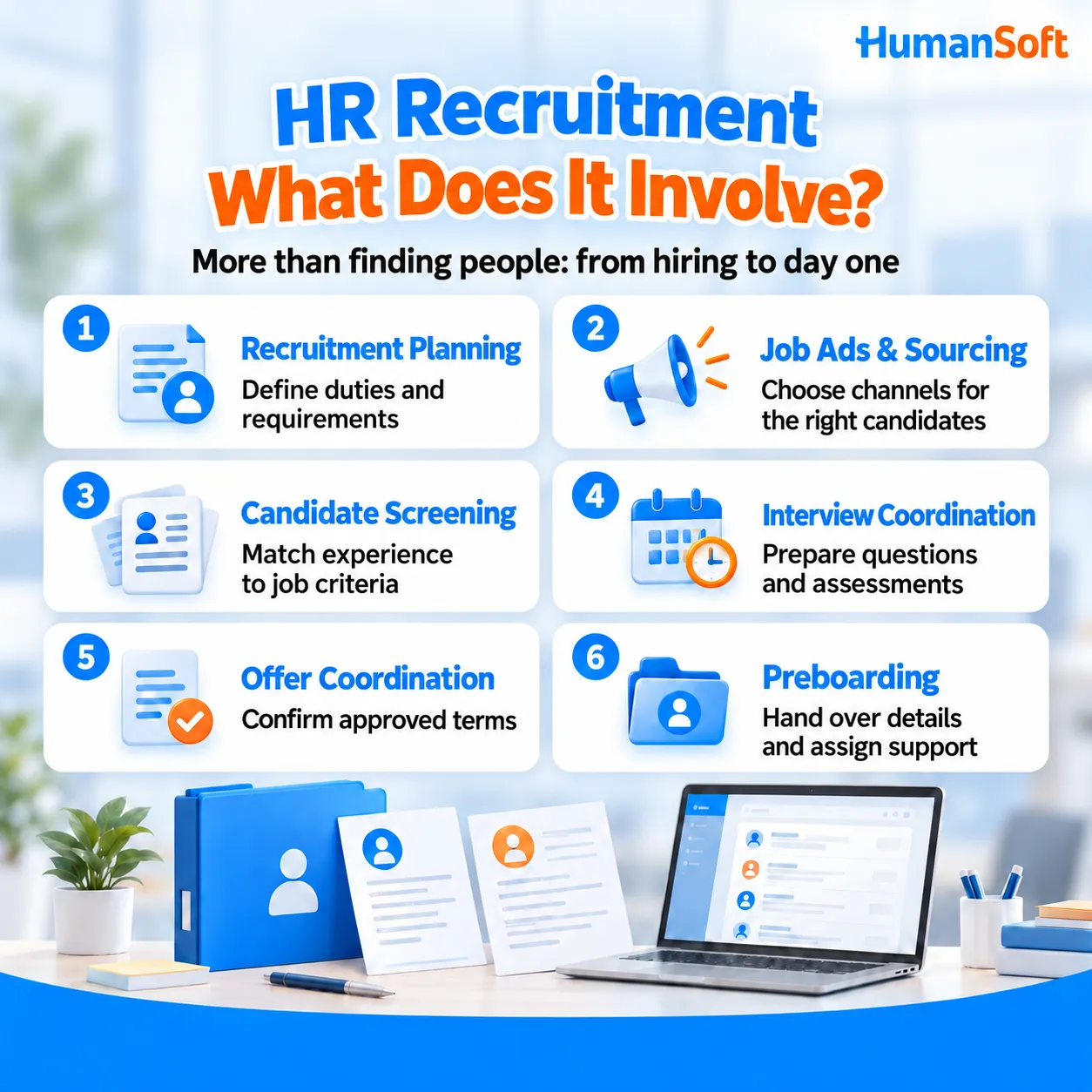
1. Clarify Hiring Needs and Plan Recruitment
Before opening a vacancy, clarify with the hiring manager what the role involves, whether it is a new position or a replacement, and when the new hire needs to start. Then agree on the budget, recruitment channels, and approvers.
- Duties and outcomes: Identify the main responsibilities and expected results for the role.
- Requirements: Separate essential qualifications from skills that can be taught later.
- Employment terms: Confirm the salary range, location, working hours, and type of employment.
- Selection plan: Identify interviewers, assessment methods, and response deadlines.
2. Write Job Ads and Choose Sourcing Channels
Prepare a job description (JD) and an advertisement that clearly communicate the duties, requirements, and employment terms. Choose channels suited to your target candidates, such as job boards, professional networks, or employee referrals, and track which channels attract suitable applicants.
3. Screen and Communicate with Candidates
Compare experience and evidence of skills against the role's criteria rather than judging candidates solely on their resume format. Ask for clarification before drawing conclusions when information is unclear, and keep candidates informed about the process, timeline, and application status.
4. Coordinate Interviews and Skills Assessments
Prepare interviewers, core questions, and scoring criteria for candidates applying for the same role. Use follow-up questions to explore details and choose assessments that reflect real work. For a customer service position, for example, ask candidates to respond to a simulated complaint.
5. Compile Results, Verify Information, and Coordinate Offers
Compile interview and assessment results for the authorized decision-maker. If reference checks are needed, inform the candidate and agree on their scope, especially before contacting a current employer. Confirm compensation and offer terms with the approver before presenting them to the candidate.
Read our guide to preparing an Offer Letter and What to Include in a Job Offer
6. Coordinate Preboarding and Review Recruitment Results
Confirm the start date, contact person, and anything the new hire needs to prepare. Pass the necessary information to the HR team and hiring manager, and check that someone is responsible for welcoming and training the new employee. Use hiring data and feedback to improve the process.
How Do Recruiters and Hiring Managers Share Responsibilities?
Recruiters keep the process moving, while hiring managers help define job standards and assess role-specific capabilities. Hiring approval must follow the organization's delegated authority. The following table provides an example you can adapt.
|
Stage |
Recruitment Team |
Hiring Manager / Approver |
|
Opening a vacancy |
Gather requirements, plan channels, and set timelines. |
Confirm the hiring need, responsibilities, and approved budget. |
|
Screening |
Check basic qualifications and coordinate with candidates. |
Clarify questions about role-specific skills. |
|
Assessment |
Schedule assessments, prepare evaluation forms, and follow up on results. |
Assess skills against the criteria and explain the supporting evidence. |
|
Job offer |
Coordinate the offer and follow up on acceptance. |
Approve the selected candidate and terms within the assigned authority. |
|
Starting work |
Confirm details and hand over to the responsible team. |
Prepare work, assign a trainer, and set initial goals. |
Example Recruitment Process: From Vacancy to First Day
Hypothetical example: A company needs one customer service employee. The following steps are suggestions to adapt, not results from a HumanSoft customer.
- Confirm the need: Agree on service channels, working hours, and the issues the employee will handle.
- Define criteria: For example, clear communication, identifying key issues, and using information to find answers.
- Advertise and screen: Review experience or work samples that demonstrate the required skills.
- Assess candidates: Use the same core questions and simulation for candidates applying for this role.
- Review results: Compare evidence against the criteria and identify anything that needs further verification.
- Make an offer and prepare for the start: Communicate approved terms, confirm acceptance, and hand over the onboarding plan.
If candidates do not meet the criteria, review the offer, sourcing channels, and whether each requirement is necessary. Avoid lowering standards or adding new requirements during selection without a clear reason.
Skills HR Recruiters Need
- Understanding the role and business: Turn “we want talented people” into measurable skills and outcomes.
- Communication and coordination: Ensure candidates and hiring managers have a shared understanding, and follow up so tasks do not remain unresolved.
- Purposeful interviewing and listening: Ask for real examples and distinguish facts from personal impressions.
- Data interpretation: Track how many candidates pass each stage and identify the causes of bottlenecks.
- Attention to detail: Keep appointments, offers, documents, and candidate statuses up to date.
HR Recruitment Metrics to Track
Consider speed, quality, and the candidate experience. Agree on consistent counting methods before making comparisons, and separate results by role type. These are example metrics, not numerical targets every company must meet.
|
Metric |
Suggested Calculation |
What It Helps You Understand |
|
Time to Fill |
Count from approval to open the vacancy until the candidate accepts the offer, using the same start and end points each time. |
Which stages take the longest, and does this vary by role? |
|
Stage Pass Rate |
Number passing the stage ÷ Number entering the stage × 100 |
Are most candidates eliminated during screening, interviews, or assessments? |
|
Offer Acceptance Rate |
Offers accepted ÷ Offers with a confirmed outcome × 100 |
Do the employment terms or the speed of communicating decisions need review? |
|
Cost per Hire |
Recruitment costs included in the calculation ÷ Number hired in the same group |
Which channels offer good value when candidate quality is also considered? |
|
Post-Hire Outcomes |
Review performance against agreed criteria and feedback from the manager and new employee. |
Do the selection criteria and information communicated reflect the actual job? |
Post-hire outcomes do not depend on recruitment alone. Training, workload, tools, and support from the manager also matter. Use the findings to improve both selection and onboarding.
Common Mistakes That Slow Recruitment
- Hiring before requirements are clear: This leads to repeated changes in job ads and screening. Agree on the criteria before starting.
- Using different standards: Compare evidence against the same job criteria and document reasons that can be reviewed.
- Using “culture fit” without defining it: Replace this with job-related behaviors, such as responding to feedback or collaborating across teams.
- Keeping candidates waiting: Assign someone to follow up and provide updates even when a final decision is still pending.
- Scattering candidate information across multiple chats: Store it in a location with access controls and share only the information assessors need.
FAQ: Frequently Asked Questions About HR Recruitment
Q: Can I start a career in HR Recruitment without experience?
A: Yes, if the position is open to beginners. Practice reading job descriptions, screening against job criteria, coordinating appointments, and recording information. Create samples such as a job ad and candidate tracker to demonstrate your approach.
Q: Do HR recruiters need a degree in human resources?
A: This depends on each company's requirements. Some accept graduates from various fields. Candidates should demonstrate communication and organizational skills, an understanding of the roles they recruit for, and the ability to use data in decision-making.
Q: Does the recruitment team make the final hiring decision?
A: Not necessarily. Recruiters usually gather information and coordinate the process. Decision-making and approval responsibilities depend on the authority assigned by the organization. Agree on these roles before opening a vacancy.
Q: Should I immediately add more channels if I cannot find candidates?
A: Identify the cause first. If few people see the ad, the channels may need adjusting. If many apply but do not meet the criteria, review the ad and requirements. If candidates decline offers, review the employment terms.
Q: What should I do if a candidate accepts but does not start work?
A: Contact the candidate to confirm their status and reasons, inform the hiring manager, and assess whether to approach a backup candidate or reopen the vacancy. Review how start dates are confirmed and how you communicate after acceptance.
Q: How should I inform unsuccessful candidates?
A: Communicate politely and clearly through the agreed channel. If providing feedback, base it on job criteria and appropriate evidence without disclosing information about other candidates.
Related Recruitment Articles You May Find Useful:


