

What Is a Taxpayer Identification Number (TIN)?
A Taxpayer Identification Number (TIN), also called a Tax ID or, for short, a tax number, is the 13-digit number the Revenue Department uses to identify each person or entity that must pay tax. Thai individuals use their 13-digit national ID card number as their Tax ID straight away, with no new application needed. Companies and partnerships registered with the Department of Business Development (DBD) use their 13-digit juristic person registration number. Anyone who has neither number, such as a foreigner without a Thai personal identification number, must apply to the Revenue Department within 60 days of first earning income.
Table of Contents:
Is the Tax ID the Same as the National ID Card Number?
Individuals and juristic persons both have a 13-digit tax number, but where the number comes from depends on the type of taxpayer. The number is used to file taxes and to deal with government agencies and other organizations. Under Section 3 Ekadasa of the Revenue Code, the Director-General of the Revenue Department has the power to require taxpayers and payers of income to obtain and use this number.
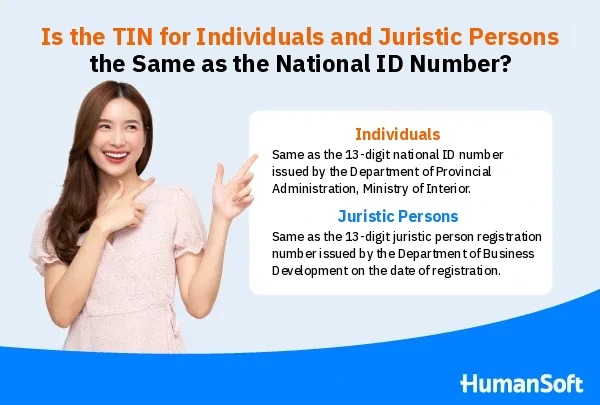
The answer: Thai individuals use the same number as their national ID card, while juristic persons use their juristic person registration number. The table below sums up the differences.
| Item | Thai individuals | Juristic persons (companies / registered partnerships) | Foreigners / ordinary partnerships / bodies of persons |
|---|---|---|---|
| Which number | 13-digit national ID number | 13-digit juristic person registration number | 13-digit number issued by the Revenue Department |
| Issued by | Department of Provincial Administration, Ministry of Interior | Department of Business Development | Revenue Department |
| Application needed? | No, use it right away | No, the number is issued at registration | Yes (if you have no Thai personal identification number) |
| Application form | — | — (juristic persons that must apply themselves use L.P.10.3) | L.P.10.1 (individuals) · L.P.10.2 (ordinary partnerships / bodies of persons) |
| Deadline | — | Within 60 days of registration or of starting business in Thailand (when filing L.P.10.3) | Within 60 days of first earning taxable income |
Thai Individuals Use Their National ID Number
Thai individuals use the 13-digit personal identification number issued by the Department of Provincial Administration, Ministry of Interior, as their tax number. There is no need to apply for a new number from the Revenue Department, and the number can be used right away to file taxes and handle other tax matters.
Sole proprietors doing business in their own name can also use this number with the Revenue Department. This cuts down on steps and duplicate paperwork, and makes dealing with government agencies and private organizations easier.
Registered Companies and Partnerships Use Their Registration Number
Limited companies, public limited companies and partnerships registered with the Department of Business Development use the 13-digit juristic person registration number they receive on the day of registration as their tax number. Juristic person registration numbers start with 0. Juristic persons that are not registered with the Department of Business Development must apply to the Revenue Department themselves using form L.P.10.3 (see the steps below).
This number plays a key role in tax work, such as issuingtax invoices, filing tax returns and doing business with both the public and private sectors. It identifies the business for its entire life as a juristic person and is also an important sign of the organization's transparency and credibility.
How to Apply for a Taxpayer Identification Number
Thai individuals and companies registered with the Department of Business Development already have a number and do not need to apply. Those who must apply to the Revenue Department are the ones without a 13-digit number from either source, by type as follows.
Foreigners, Ordinary Partnerships and Bodies of Persons (L.P.10.1 / L.P.10.2)
Foreigners without a Thai personal identification number, as well as ordinary partnerships and bodies of persons that are not registered as juristic persons, must apply to the Revenue Department within 60 days of first earning taxable income. The steps are as follows.
- Choose the right form: L.P.10.1 for individuals, or L.P.10.2 for ordinary partnerships or bodies of persons. Download it from theRevenue Department website
- Prepare supporting documents: such as a passport, an alien registration certificate, or a partnership or body-of-persons agreement, as required by the form.
- Submit the application at your area Revenue office: within 60 days of first earning taxable income.
- Receive your 13-digit number: to use for filing returns and other tax transactions.
Juristic Persons That Must Apply Themselves (L.P.10.3)
Juristic persons such as companies or limited partnerships registered with the Department of Business Development receive a 13-digit juristic person registration number on the day of registration and use it as their tax number for the life of the business. Juristic persons that must apply to the Revenue Department themselves should follow these steps.
- Use form L.P.10.3: the application for a taxpayer identification number for juristic persons.
- Prepare supporting documents: such as a certificate of registration or documents showing the start of business in Thailand, as required by the form.
- Submit to your area Revenue office within 60 days: of registering as a Thai juristic person, or of starting business in Thailand in the case of a foreign juristic person.
Applying on time keeps your business compliant with tax law. See the latest forms and details at theRevenue Department and juristic person registration information at theDepartment of Business Development
How Do You Check a Taxpayer Identification Number?
- Your own (Thai individuals): the 13 digits on your national ID card.
- A business partner's: check their company certificate or tax invoices, or search the company name in the business database of theDepartment of Business Development
- VAT-registered businesses: check through the online service of theRevenue Department
A Quick Check for Typos
The 13th digit of a national ID number is a "check digit" calculated from the first 12 digits. HR can use it to check a number before filing a return.
- Multiply the first 12 digits by 13, 12, 11 … down to 2 in order, then add up the results.
- Divide the total by 11 and take the remainder.
- Check digit = (11 − remainder), keeping only the last digit.
Example: number 1-2345-67890-12-? → (1×13) + (2×12) + (3×11) + (4×10) + (5×9) + (6×8) + (7×7) + (8×6) + (9×5) + (0×4) + (1×3) + (2×2) = 352 → 352 ÷ 11 leaves a remainder of 0 → 11 − 0 = 11 → last digit= 1. The correct number is 1-2345-67890-12-1 (a made-up number).
When Does HR Need Employees' Tax IDs?
As the "payer of income," the employer must use every employee's tax number for payroll tax work, namely:
| Document | Purpose | Frequency |
|---|---|---|
| P.N.D.1 | Filing income tax withheld at source from employees' salaries | Every month |
| P.N.D.1 Kor | Annual summary of each employee's income and tax withheld | Once a year |
| Withholding tax certificate (50 Tawi) | Given to employees for filing their annual income tax | Once a year and when an employee resigns |
HR should therefore check every employee's number before filing. If an employee is a foreigner without a Thai personal identification number, HR should have them apply with form L.P.10.1 when they start work so the first month's P.N.D.1 can be filed in full. Thai employees can use their national ID number right away. For an overview, seepersonal income tax in brief andthe 2026 tax calendar
HumanSoft payroll software stores each employee's tax number in their employee record and pulls it into P.N.D.1 and 50 Tawi reports automatically, so there is no need to re-key the number every month.
FAQ: Common Questions About Taxpayer Identification Numbers
Q: Is the Taxpayer Identification Number the same as the national ID card number?
A: Yes, for Thai individuals. They can file taxes with their 13-digit national ID number right away without applying for a new number from the Revenue Department. Companies and partnerships registered with the Department of Business Development use their 13-digit juristic person registration number instead.
Q: Do foreigners working in Thailand need to apply for a Taxpayer Identification Number?
A: Yes. If they have taxable income in Thailand but no Thai personal identification number, they must file form L.P.10.1 at their area Revenue office within 60 days of first earning income.
Q: Are the tax number, the taxpayer identification number and the Tax ID the same number?
A: Yes. The full name the Revenue Department uses on its forms is the taxpayer identification number (Lek Prajam Tua Phu Sia Phasi Akorn). "Tax number" is the short form, and Tax ID (Tax Identification Number) is the English name for the same 13-digit number.
Q: Whose tax numbers go on a 50 Tawi certificate?
A: Two numbers are required: the tax number of the payer who withholds tax at source, which is the employer company, and the number of the person whose tax is withheld, which is the employee. Thai employees use their 13-digit national ID number, while foreign employees use the number issued by the Revenue Department.
Q: Does the tax number change after a change of first name or surname?
A: No. For Thai individuals, the tax number is the 13-digit national ID number, which does not change with a name change. HR should still update the new name in the employee record to match the ID card before issuing P.N.D.1 and 50 Tawi documents.
Further Reading
- 50 Tawi: What It Is and When Employers Must Issue It
- Q&A: What Is a Withholding Tax Certificate and Who Issues It?
- Calculating Withholding Tax on Employee Salaries
- How Much Salary Is Taxable? Progressive Tax Rates Explained
- P.N.D.90 vs P.N.D.91: What They Are and How They Differ
- Q&A: Is Severance Pay Taxable?
