
Employee Absent and Unreachable: What Should Managers and HR Do First?
If an employee does not show up for work and cannot be reached, the manager should call and message the employee and their emergency contact on the first day, record the time of every contact attempt, notify HR, and arrange temporary cover. Do not assume the employee has resigned. Dismissal without severance pay on this ground requires absence for three consecutive working days without a justifiable reason.
Table of Contents:
- Employee Absent and Unreachable: What Should Managers and HR Do First?
- An Employee Is Missing on Day One: What Should Managers Do in the First Two Hours?
- The First Three Days: What Should Managers and HR Do?
- What If the Employee Responds Later and Has a Valid Reason?
- How Can You Handle Pending Work Without Disrupting the Team?
- How Can You Prevent Unexplained Absences from Happening Again?
- Still Unreachable After Three Days: What Happens Next?
- Summary: What Should Managers Do When an Employee Is Absent and Unreachable?
An Employee Is Missing on Day One: What Should Managers Do in the First Two Hours?
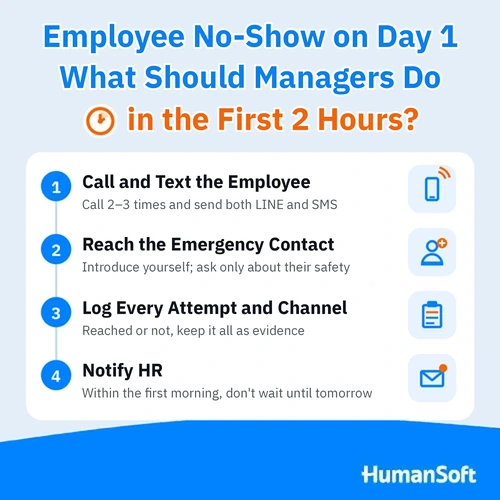
Within the first two hours after the scheduled start time, managers should take four steps: contact the employee, contact their emergency contact, document every attempt, and notify HR. The aim is to establish as quickly as possible whether the employee is safe and retain evidence of the company's efforts to reach them.
Call and Message the Employee
Call the employee 2–3 times, approximately 15 minutes apart. Then send messages via both LINE and SMS in case they have no internet access. Keep messages brief, polite, and free of accusations.
Contact Their Emergency Contact
If you cannot reach the employee by phone, call the emergency contact they provided to the company. Introduce yourself and your company, and ask only about the employee's safety. Do not discuss work matters or the consequences of absence from work with them.
Record the Time and Channel of Every Contact Attempt
Record every attempt, whether successful or unsuccessful, in a single file or system. This record will be important evidence if further action is needed after three days.
|
Date and Time |
Channel |
Person Contacted |
Outcome |
|
5 Nov., 9:15 a.m. |
Phone |
Employee |
No answer |
|
5 Nov., 9:20 a.m. |
LINE + SMS |
Employee |
No reply yet (screenshot saved) |
|
5 Nov., 10:30 a.m. |
Phone |
Emergency contact (older sister) |
Did not know the employee's whereabouts; agreed to help contact them. |
Notify HR
Notify HR within the first two hours. Do not wait to see whether the employee returns tomorrow. Provide HR with the following information:
-
Employee name, position, and usual start time
-
All contact attempts, including times and outcomes
-
Affected tasks and the person temporarily covering them
The First Three Days: What Should Managers and HR Do?
The first three days have two objectives: locate the employee as quickly as possible and retain evidence that the company has made genuine efforts to contact them. Divide responsibilities as shown below.
|
Day |
Manager's Actions |
HR's Actions |
Evidence to Retain |
|
Day 1 |
Complete the four steps above within the first two hours, arrange cover for urgent work, and try contacting the employee again in the afternoon. |
Check the system for leave requests, scheduled days off, or pending leave notifications. Provide the manager with the emergency contact number and latest address. Open an incident record for the employee. |
Call history (date, time, and number), screenshots of messages, and “read” status |
|
Day 2 |
Try contacting the employee again in the morning and afternoon. Send a brief message asking them to respond, and inform the team about temporary task assignments. |
Send an official company message or email asking the employee to explain their absence and return to work. Send a registered letter with acknowledgment of receipt to the address provided to the company, and record the days of absence in the system. |
Copies of official company messages or emails and the registered-mail receipt |
|
Day 3 |
Make another contact attempt, then submit a complete timeline of events to HR. |
Compile all evidence, consult management or the legal team, and prepare the next steps for after three full working days have elapsed (do not issue a termination letter during this period). |
A timeline of events signed and verified by the manager and HR |
If further action is needed after three days, the combined evidence from all three days will be used to establish that the employee was absent “without a justifiable reason.”
What If the Employee Responds Later and Has a Valid Reason?
If the employee gets in touch with a valid reason, listen to their explanation first, request supporting evidence appropriate to the circumstances, and have them submit a retrospective request for the relevant type of leave. If the reason is justifiable, the absence does not constitute abandonment of duties, so the three-day rule does not apply.
|
Situation |
Examples |
Supporting Evidence You May Request |
HR Follow-Up |
|
Illness or hospitalization |
Sudden illness or an accident |
A medical certificate (an employer may request one for sick leave of three working days or more; if unavailable, ask the employee to explain why) |
Have the employee submit a retrospective sick leave request. |
|
Family emergency |
A seriously ill family member or a death in the family |
Relevant documents, such as a death certificate |
Have the employee request personal business leave under their entitlement, or retrospective annual leave if company rules allow it. |
|
Force majeure |
A natural disaster or a genuine inability to communicate |
Evidence or news reports confirming the event |
Record the explanation and assess the case individually. |
|
No justifiable reason |
Forgot to notify the company or did not want to come to work |
_ |
Consider disciplinary action under company rules, such as a written warning. |
For leave entitlements by category, see Leave Entitlements Under Thai Labour Law. Where there is no justifiable reason, use these Employee Warning Letter Examples as a guide.
When the employee returns, the manager should speak with them privately, ask whether they need support, and agree on how they will notify the company next time. An understanding conversation can uncover underlying issues, such as workload or personal problems, that may have contributed to the absence.
How Can You Handle Pending Work Without Disrupting the Team?
On the first day, the manager should list outstanding tasks, prioritize them by urgency, and clearly assign temporary responsibility and deadlines.
-
List outstanding work using the employee's task management system, emails, and calendar appointments.
-
Prioritize urgent tasks. Work with client deadlines or an impact on other teams should come first.
-
Assign temporary cover, naming the person responsible and the completion date for each task.
-
Request access to necessary files through IT under company policy. Do not use the employee's password.
-
Tell clients or relevant parties that someone is temporarily covering the work, without disclosing personal circumstances.
-
Hand work back when the employee returns, with a summary of progress on each task.
How Can You Prevent Unexplained Absences from Happening Again?
Set clear procedures for notifying the company of leave, make leave requests easy to submit, and help managers quickly identify employees who have not reported for work.
-
Include leave notification procedures in company rules, such as notifying the manager before the scheduled start time by phone or through the leave system, and explain the consequences of failing to notify anyone.
-
Ask employees to update their emergency contact details annually and whenever they move or change phone numbers.
-
Use an online time attendance system and an online leave management system so employees can request leave immediately from their phones. Configure the system to send a list of absent employees to the managers' notification group at a scheduled time.
-
Hold regular one-to-one conversations and watch for signs such as frequent lateness, excessive workloads, or visible stress.
-
Explain the rules on the first day of employment so new employees know how to report leave and understand the consequences of absence without notice.
Still Unreachable After Three Days: What Happens Next?
If an employee is absent for three consecutive working days without a justifiable reason, this constitutes abandonment of duties under Section 119(5) of the Labour Protection Act B.E. 2541 (1998). The employer may dismiss them without severance pay, but must issue a termination letter clearly stating the reason, send it to the employee's address by registered mail with acknowledgment of receipt, pay outstanding wages for the days actually worked, and report the end of employment to the Social Security Office using Form SSO 6-09 by the 15th of the following month. For step-by-step guidance, see Employee Abandonment: How Employers Should Handle a Three-Day Absence Legally
Summary: What Should Managers Do When an Employee Is Absent and Unreachable?
When an employee is absent and unreachable, the manager should contact the employee and their emergency contact on the first day, document every attempt, notify HR, and arrange temporary cover to keep the team working. If the employee responds with a valid reason, have them submit a retrospective leave request under their entitlement. If they remain unresponsive after three consecutive working days without a justifiable reason, HR can begin the legal termination process.
FAQ About Employees Who Are Absent and Unreachable
Q: If an Employee Reads a LINE Message but Does Not Reply, Have They Been Successfully Contacted?
A: Not yet, because the employee has not explained their absence or requested leave. Save a screenshot showing the read status with the date and time, and ask them to respond by a specified deadline. Continue recording the days as absences in the meantime.
Q: Can a Manager Visit an Employee's Home?
A: Yes, to check on their welfare. The manager should go with HR, avoid entering without permission, and record the outcome. If a visit is impractical, send a registered letter with acknowledgment of receipt instead.
Q: Can an Employee Be Dismissed for One Day of Absence Without Notice?
A: This reason alone does not yet justify dismissal without severance pay. Abandonment of duties under Section 119(5) requires three consecutive working days of absence. For a one-day absence, the employer does not have to pay wages for the day not worked and may impose disciplinary action under company rules, such as a written warning.
Q: Do Absences on Friday and Monday Count as Consecutive Days?
A: Yes. Section 119(5) counts three consecutive working days regardless of intervening days off, but days off do not count as days of absence. If the company closes on Saturdays and Sundays, missing Friday and Monday counts as two working days; the employee would also need to miss Tuesday to reach three. If Saturday is a working day, absence on Friday, Saturday, and Monday amounts to three consecutive working days.
Read More Related Articles
