
How Long Do Social Security Benefits Continue After Resignation, and Should You Apply for Section 39?
After leaving a job, certain Social Security benefits may continue for another six months without requiring additional contributions.
Those who want to maintain continuous coverage beyond this period and do not yet have a new employer should apply to become voluntarily insured under Section 39 within six months of leaving employment.
How Long Can You Continue Using Social Security Benefits After Resignation?
An insured person under Section 33 who resigns or ceases to be an employee remains protected for another six months from the date their insured status ends, without having to make further contributions.
This continued protection is provided under Section 38 and covers four benefit categories:
- Sickness
- Maternity
- Invalidity
- Death
Eligibility for each benefit remains subject to the applicable contribution requirements and other conditions.
Do You Need to Apply for Social Security under Section 39 After Resignation?
Whether you should apply for Social Security coverage under Section 39 depends on your circumstances and whether you want to maintain continuous coverage. The decision can generally be considered under the following two situations.
Situations in Which You Should Consider Applying for Section 39
You may consider applying if you:
- Do not yet plan to begin working for a new employer
- Want to maintain continuous medical benefits
- Want to continue making contributions toward old-age benefits
- Are currently receiving child allowance benefits
- Want continued protection for maternity, invalidity, or death
- Want to prevent your coverage from ending after the six-month period
Situations in Which You May Not Need to Apply for Section 39 Yet
You may not need to apply if you:
- Are about to begin a new job and will return to Section 33
- Only need the six-month continued coverage after resignation
- Already have sufficient healthcare coverage from another scheme
- Do not want to continue making Social Security contributions yourself
What Is the Difference Between Section 38 and Section 39 After Resignation?
After leaving employment, an insured person may continue receiving Social Security protection under certain conditions.
Section 38 and Section 39 differ in terms of the duration of coverage, contribution requirements, and benefits provided.
| Topic | Section 38 After Resignation | Section 39 |
|---|---|---|
| How coverage is obtained | Coverage continues automatically after Section 33 status ends | The insured person must submit an application |
| Coverage period | Six months after insured status ends | Continues while the person maintains their status and makes contributions |
| Contributions | No contributions required | Currently THB 432 per month |
| Number of covered benefit categories | Four categories | Six categories |
| Medical benefits | Available subject to eligibility conditions | Available subject to eligibility conditions |
| Child allowance | Not included in the six-month protection under Section 38 | Covered |
| Old-age benefits | Previous contributions remain recorded | The insured person can continue contributing |
| Unemployment benefits | May be claimed based on the former Section 33 status, subject to eligibility conditions | Not covered |
| Application deadline | No application required | Must apply within six months of leaving employment |
Are You Entitled to Unemployment Benefits After Resignation?
An insured person under Section 33 who resigns may still be entitled to unemployment compensation if they have paid contributions for at least six months within the 15 months before becoming unemployed.
The person must also have been unemployed for at least eight consecutive days, register as unemployed within 30 days from the date of leaving employment, and comply with the applicable requirements.
In cases of voluntary resignation or the expiry of a fixed-term employment contract, the insured person may receive compensation equal to 30% of the wage used as the contribution base, for no more than 90 days per calendar year.
The actual amount received depends on the person’s contribution wage base and individual eligibility.
Learn more: อัปเดตอัตราประกันสังคมว่างงาน เงินทดแทนเพิ่มขึ้นเท่าไหร่บ้าง
What Must HR Do When an Employee Resigns?
When an employee resigns, HR is responsible for completing three main tasks.
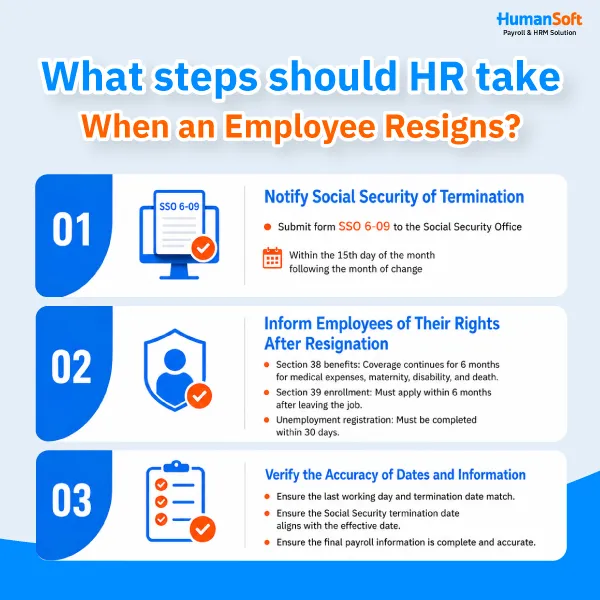
1. Report the End of the Employee’s Insured Status
HR should:
- Submit Form SSO 6-09 to the Social Security Office
- Complete the submission by the 15th day of the month following the month in which the employee’s status changed
2. Inform the Employee About Their Benefits After Resignation
HR should explain that:
- Section 38 provides continued coverage for another six months for sickness, maternity, invalidity, and death
- An application for Section 39 must be submitted within six months of leaving employment
- Registration as an unemployed person must be completed within 30 days
3. Verify the Accuracy of Dates and Information
HR should confirm that:
- The employee’s final working day and termination date are consistent
- The date reported to Social Security matches the employee’s termination date
- The employee’s final payroll information is complete and accurate
Learn more: วิธีการแจ้งออกประกันสังคมเมื่อมีพนักงานลาออก สำหรับนายจ้าง
Summary: How Long Do Social Security Benefits Continue After Resignation, and Should You Apply for Section 39?
After leaving employment, an insured person under Section 33 continues to receive protection for another six months without making additional contributions under Section 38.
This protection covers sickness, maternity, invalidity, and death, provided that the insured person meets the eligibility conditions for each benefit.
Applying for Section 39 is suitable for people who do not yet have a new employer and want to maintain continuous Social Security coverage.
Applicants must have previously paid Section 33 contributions for at least 12 months and must apply within six months of leaving employment.
References
FAQ: Frequently Asked Questions About Social Security Benefits After Leaving Employment
How many months can I continue using Social Security benefits after resignation?
Answer: Certain benefits remain available for another six months after your Section 33 insured status ends, without requiring additional contributions.
Can I still use my existing Social Security hospital after resignation?
Answer: Yes, while you remain covered under Section 38 and meet the applicable contribution requirements.
You should check your registered hospital and current benefit status before receiving medical services.
Do I need to apply for Section 39 immediately after resignation?
Answer: No. You do not need to apply immediately.
However, once you decide to apply, you must submit your application within six months of leaving employment.
Can I receive unemployment benefits if I resign voluntarily?
Answer: Yes, provided that you meet the eligibility requirements and register as unemployed within 30 days.
According to the source document, a person who resigns voluntarily may currently receive compensation equal to 30% of the contribution wage base for no more than 90 days per calendar year.
Can I apply for Section 39 more than six months after resigning?
Answer: In general, you cannot apply based on your former Section 33 status once the six-month application period has passed.
To become insured under Section 39 later, you would generally need to return to Section 33 employment and meet the eligibility requirements again. Alternatively, you may consider Section 40 depending on your occupation and employment status.
Learn more: ประกันสังคมมาตรา 33, 39 และ40 มีข้อแตกต่างกันอย่างไรบ้าง?
Read more related articles